Blog
What does an international SEO audit cover?
An international SEO audit checks whether Google can tell a site's country and language versions apart. Here is each check, and what the audit leaves open.
If you have been offered an international SEO audit, or are about to pay for one, it helps to know what one should contain. An audit of this kind is a written review of how a website handles more than one country or language. This post goes through the four checks in our audit and what Google’s own documentation says about each. It then covers what an audit does not settle, what you should be holding when it ends, and how the price is set.
What are SEO audits, and what does an international one add?
An SEO audit is a review of a site against what a search engine needs in order to find its pages, read them and show them in results. The usual one stops there. An international audit asks one more question: when a site has versions for several countries or languages, which version does a search engine show to whom?
Google’s guide to managing multi-regional and multilingual sites draws the line this way. A multilingual site offers its content in more than one language. A multi-regional site explicitly targets users in different countries. Some sites are both.
A site in one language for one country is neither. In our view it does not need this audit.
The four checks in the audit
Each check rests on guidance Google publishes. The sources are linked under the table.
| What the audit checks | What Google's documentation says | What a finding looks like |
|---|---|---|
| How the URLs, the web addresses, are divided between countries and languages | Google recommends a different URL for each language version of a page, not cookies or browser settings that switch the language on one URL | Two language versions that share one URL |
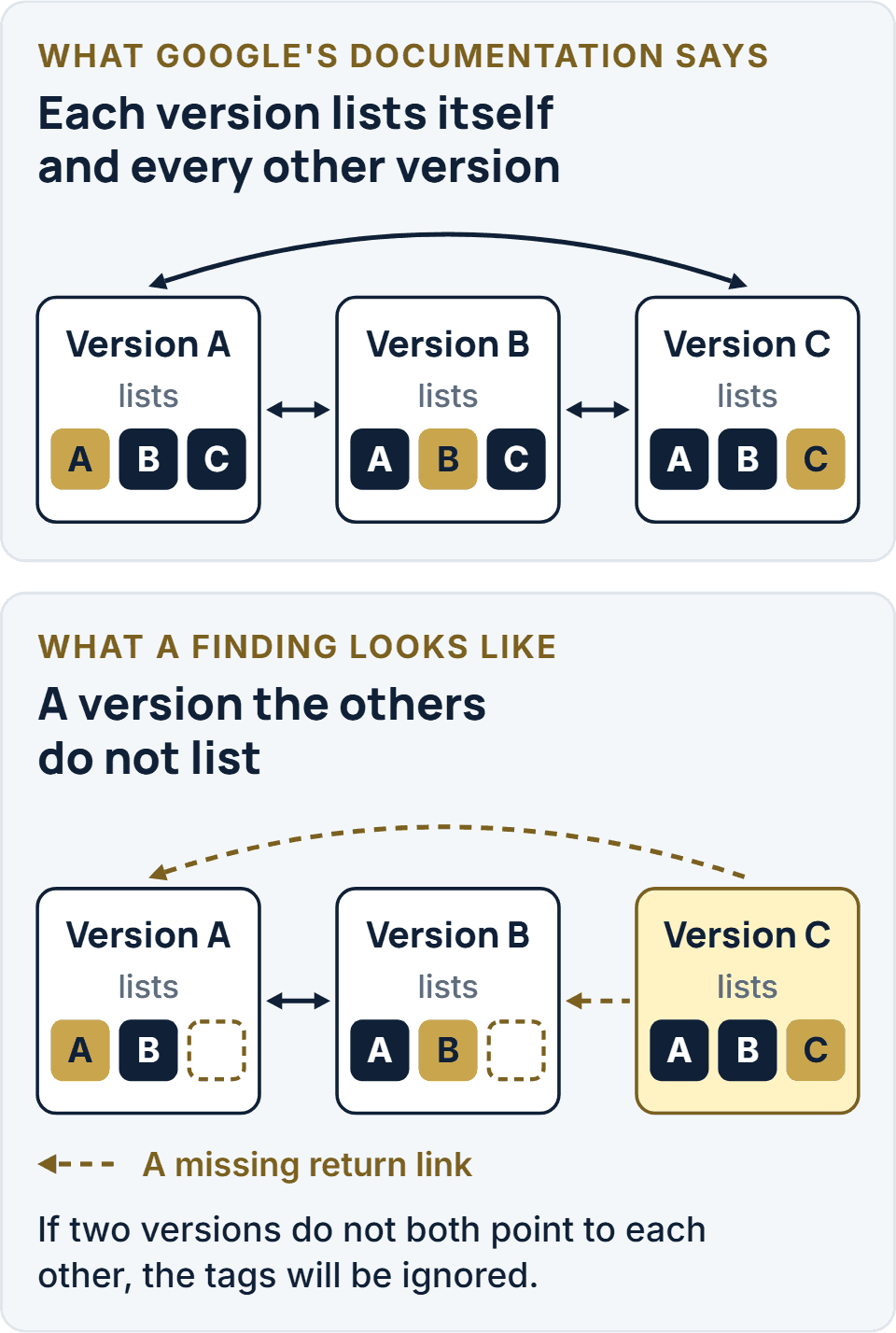
| hreflang tags, lines in a page's code that list every language and country version of that page | Each version must list itself and every other version. If two versions do not both point to each other, the tags will be ignored. A fallback page can be named for languages that match no version | A version the others do not list |
| Canonical tags, the line in each page's code that names the address counting as that page's main one | A page with hreflang tags should name a canonical page in the same language, or in the best possible substitute language if there is none | A translated page whose canonical tag points to the original |
| Redirects by location | Google says not to use IP analysis to adapt content, and advises against automatically redirecting visitors from one language version to another. Such redirects could prevent visitors and search engines from seeing every version | Every visitor sent to one version, whichever URL they asked for |
The guidance on URLs and on redirects comes from the Google guide linked above. On redirects, its page on locale-adaptive pages adds that Google might not crawl, index or rank all the content of a site that returns different content by the visitor’s perceived country or preferred language.
The hreflang rules are on its page about localized versions of a page, which also lists the most common mistakes: a missing return link, an incorrect language code and an incorrect region code. Among its examples of an incorrect region code is “UK”, which Google says has no effect in an hreflang annotation. The canonical guidance is from its page on specifying a canonical URL.
Is the right page showing in each country?
That is the question the four checks exist to answer, and you can look at it yourself. Your site’s own search data, the record of which searches showed which of your pages, can be split by country. If people in one country keep landing on another country’s page, the setup above is the first place to look.
The audit reviews that setup. It does not measure the result, and a correct setup does not end every case of the wrong page showing. In its guide to these sites Google says geotargeting, its word for aiming a site at a country, “isn’t an exact science”, and that it is important to consider users who land on the wrong version. One way it suggests is links on every page that let a visitor choose their region or language.
What the audit does not settle
The search terms people use in each market, the pages a market still needs and links from sites in each country are all part of international SEO. They are not part of our audit. It is the technical review above and nothing more. Deciding which page should answer which search in each market, planning the missing pages and building links are monthly work that follows it, within an agreed scope. Which languages are in scope, and who writes the pages in each, is agreed with you after the audit.
An audit also cannot tell you whether to enter a country at all. If the business cannot yet sell to and serve customers there, it is too early for one.
What you should have at the end
Findings in writing, the most urgent first. Each one should name the pages it affects and the change it calls for, plainly enough for a developer to act on. Our findings stay yours whether or not you continue.
They get acted on in the monthly work that follows, in one of two ways. Our team makes the changes, as far as your platform allows and with the access you give us. Or we write a specification for your developers and check what they ship.
One finding is larger than the rest. If the audit calls for a different URL structure, that is a site move, and Google’s page on site moves with URL changes says to expect a temporary fluctuation in ranking while it recrawls and reindexes the site. We quote that work separately.
How much does the audit cost?
We do not publish a figure, because the price depends on the site. The first call is free. The audit is a paid step, done once, and we give you its price before it starts.
The monthly work has its own fee, fixed for the scope we agree with you after the audit.
Whoever quotes you, ask which checks the price covers and whether the findings are yours if you go no further.
We do international SEO for WordPress, Shopify and custom-built sites, as a service on its own and for sites we did not build.
The full service behind this post: International SEO Consultant Services.
Ready to scope your project?
Send us two sentences about what you need. We reply within one business day with the next step and any questions we need answered first.