
Blog
Legal practice SEO: what the work is, part by part
Legal practice SEO is the work that helps people searching for a lawyer find a firm's website and profile. Here is each part, with what Google says about it.
A firm that is offered legal practice SEO is often told what it will achieve before anyone says what the work is. This post is for the lawyer or practice manager who wants the work described first. It sets out the work, then covers which parts need the firm’s own lawyers, whether SEO is still worth doing, and cost. We write as a software company that does this work, not as lawyers, and nothing in this post is legal advice.
What is SEO for lawyers?
Google’s SEO Starter Guide describes SEO, short for search engine optimization, as helping search engines understand your content, and helping users find your site and decide whether to visit it.
For a law firm, the content is the firm’s own pages: what it does, who its lawyers are, and the questions it answers for the people it wants as clients. The firm’s Google Business Profile counts too: it is the listing Google can show beside a map of nearby firms. The users are people looking for a lawyer, or for an answer to a legal problem.
SEO is not advertising. Google’s page on whether you need an SEO says advertising with Google has no effect on a site’s presence in its search results. Paid listings are bought separately and are no part of this work.
The parts of the work, and what Google says about each
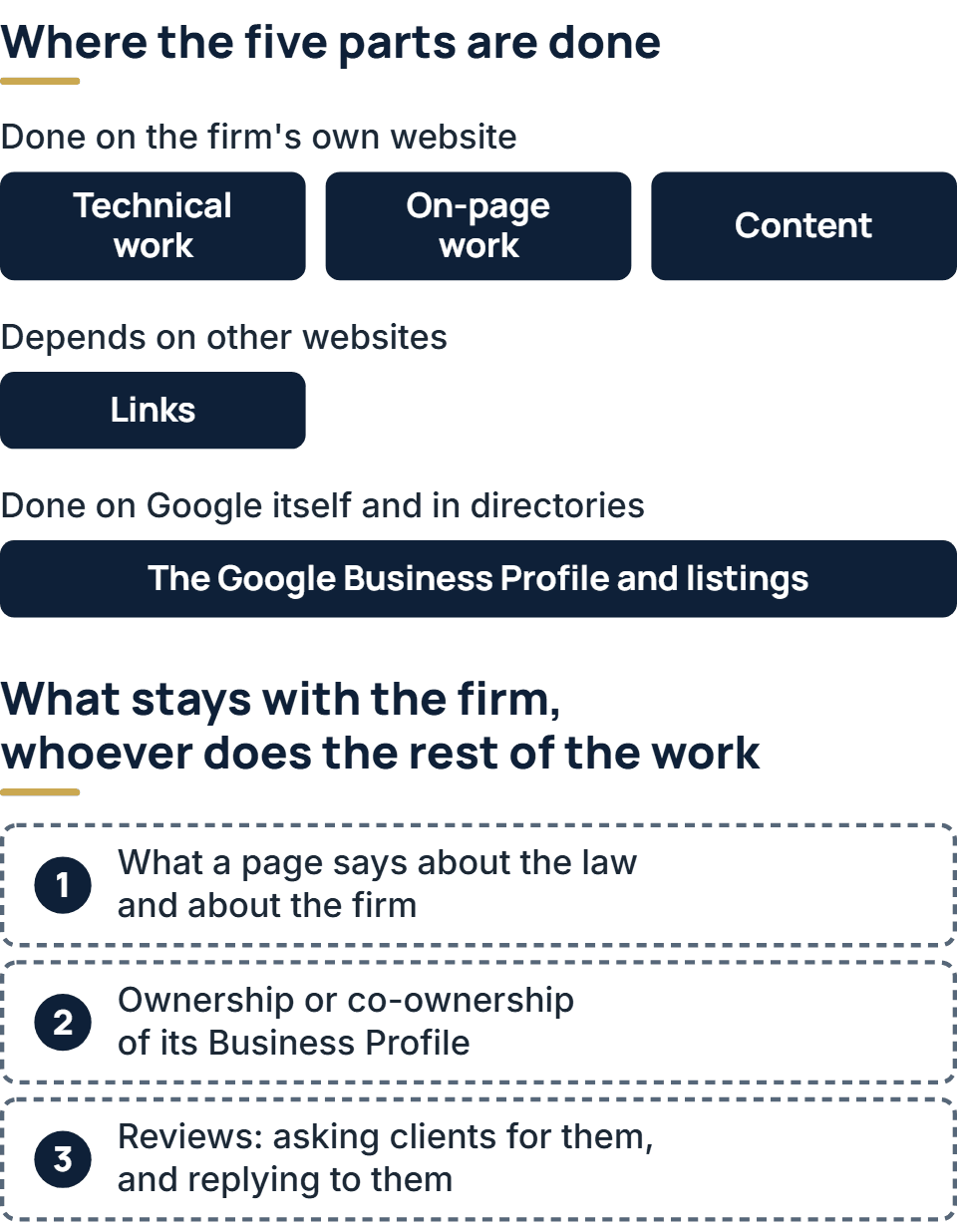
The work has five parts. The first three are done on the firm’s own website. The fourth depends on other websites. The fifth is done on Google itself and in directories.
| Part of the work | What it is | What Google's documentation says |
|---|---|---|
| Technical work | Checking whether Google can reach and read every page that should be found, then fixing what stops it | Search works in three stages: crawling (fetching pages), indexing (analyzing and storing them) and serving results. Not all pages make it through each stage |
| On-page work | Each page's title, its description for search results (the meta description) and its headings | A good title is unique to the page, clear and concise, and describes the page accurately. The snippet under a result is taken from the page's own content, and occasionally from its meta description |
| Content | Pages that answer what people ask before they hire a lawyer | Content that people find compelling and useful will likely influence a site's presence in search results more than any other suggestion in the Starter Guide |
| Links | Other websites linking to the firm's pages. Only the other site decides whether it links | Google finds pages primarily through links from pages it has already crawled. Links from other sites happen naturally over time, and promoting the site can help people discover it |
| The Google Business Profile and listings | The firm's details on Google and in directory listings, kept accurate | A better local ranking cannot be requested or paid for. Google bases local results mainly on relevance, distance, and how well known a business is |
The three stages are from Google’s guide to how Search works. The guidance on titles, snippets, content and links is in the Starter Guide linked above. On content, Google’s page on helpful, reliable, people-first content also suggests asking whether it is clear who wrote a page, and whether someone who demonstrably knows the topic well wrote it or reviewed it. The statements on local results are from its help page on local ranking.
An audit is how a provider finds out which of these a firm’s site needs first. A monthly report is how the firm sees what was done. Neither is a sixth part.
Which parts need the firm’s lawyers?
Three things stay with the firm, whoever does the rest of the work.
The first is what a page says about the law and about the firm. A page about a legal problem needs a lawyer to supply the law in it and to approve what it says. What a firm may say about itself is for its lawyers to decide, under the professional conduct rules that apply to them. That judgment is not ours.
The second is the Business Profile. Google’s policies for third parties say a business working with a third party must keep ownership or co-ownership of it at all times.
The third, as we see it, is reviews: asking clients for them, and replying to them.
When we do this work, we draft each page from what the firm’s lawyers tell us, and one of them approves it before it is published. The same goes for anything else that describes the firm, such as titles, descriptions and listings. The firm owns what we write and stays the owner of its Business Profile. We do not reply to reviews, and we write no testimonials.
Is SEO still worth it for a law firm?
Nobody can answer that for a firm from outside it. Google’s page on whether you need an SEO, linked above, says to beware of SEOs that claim to guarantee rankings, and puts it in one line: “No one can guarantee a #1 ranking on Google.” The guide to how Search works adds that Google does not guarantee it will crawl, index or serve a page, even one that follows its Search Essentials.
Time is the second caution. The Starter Guide says some changes might take effect in a few hours and others could take several months. That is Google on how long a change takes to show, not a timeline of ours.
Often the worry behind “still” is the AI answers Google now shows in search. Google’s page on AI features says the best practices for SEO remain relevant for these features, which it calls AI Overviews and AI Mode, and that there are no additional requirements to appear in them.
The answer depends on how a firm’s kind of client searches, and on how many firms want the same searches. We promise no position in search, no number of inquiries and no date.
What is the typical cost?
We cannot give a typical figure: the work differs from firm to firm, and a number taken from someone else’s page would be their price. We publish no prices of our own.
The first call with us is free. An audit comes next, at a price agreed before it starts, and after it a monthly fee for a written list of work.
Our SEO work for law firms has its own page. It says what we do, what stays with the firm, and how the fee changes when the list does.
The full service behind this post: SEO Services for Lawyers and Law Firms.
Ready to scope your project?
Send us two sentences about what you need. We reply within one business day with the next step and any questions we need answered first.