
Blog
React vs Angular vs Vue: how to choose for a business app
React vs Angular vs Vue compared on what each includes, how long versions are supported, and who maintains them, with five questions that settle the choice.
React has the most developers and the largest set of add-on libraries, but it is a library for building interfaces, so routing, data loading and server rendering come from a framework you choose on top of it, usually Next.js or React Router. Angular is a complete framework maintained by a team at Google, written for TypeScript, with a published support window for every major version, which suits large teams and internal systems that will live for years. Vue gives you a core library with an official router and state library, leaves TypeScript optional, and can be added to one page of an existing site. It is maintained by its core team with funding from sponsors, with a smaller hiring pool than React. All three are free under the MIT license and fast enough for almost any business app. The difference that costs money comes later, in what you have to choose, update and hire for.
React, Angular and Vue at a glance
Versions are the latest on npm on 30 October 2026.
| React | Angular | Vue | |
|---|---|---|---|
| What it is | “The library for web and native user interfaces” | A web framework | “A JavaScript framework for building user interfaces” |
| Maintained by | The React team; since February 2026 React is owned by the React Foundation, hosted by the Linux Foundation, rather than by Meta | A team at Google | The Vue core team, with funding from sponsors |
| Language | JavaScript or TypeScript, with JSX | TypeScript | JavaScript or TypeScript, usually in single-file components |
| Routing, forms, HTTP | From a framework or third-party libraries | Included | Official router and state library; the rest from libraries |
| Server rendering | Through a framework such as Next.js or React Router | Set up by the Angular CLI | Built-in APIs, or a framework such as Nuxt |
| Release policy | No fixed schedule; security fixes backported to affected major versions | One major a year since v22; majors typically supported for 24 months | No fixed schedule; minor releases every 3 to 6 months |
| Latest version | 19.3.1 | 22.2.4 | 3.5.44 |
| License | MIT | MIT | MIT |
What each one leaves you to choose
Angular puts most decisions in one box. Its overview lists routing, forms, server-side rendering, a command-line tool and an update command, and its HTTP guide documents HttpClient, the built-in way to call your back end. Its Essentials guide says the docs expect you to be familiar with HTML, CSS and TypeScript before you start. Two Angular projects therefore tend to look alike, which helps when developers move between teams or a new one inherits the code.
Vue gives you the core and a small set of official pieces. Its docs recommend the officially supported Vue Router for single-page apps and Pinia, which the Vue core team maintains, for shared state. Vue is written in TypeScript and supports it fully, but does not require it. Its introduction calls it “incrementally adoptable”: you can add it to one page of an existing site or build a whole app with it.
React gives you the least out of the box, on purpose. React’s own guide to creating a React app says that for a new app or website “we recommend starting with a framework”, and names Next.js, maintained by Vercel, and React Router, maintained by Shopify. So a business that picks React is really picking React plus a framework, and a comparison that puts React next to Angular is closer to Next.js against Angular. Each library you add for forms, data fetching or state is another dependency with its own releases to follow.
How long each version is supported
This is the part comparison articles skip, and it decides what an app costs to keep safe after launch.
Angular publishes the most precise policy of the three. Its releases page sets out a major release every 12 months, with each major typically supported for 24 months: 12 months of active development, then 12 months of long-term support with critical and security fixes only. That cadence began with Angular 22; the page notes that until then majors came every six months, which is why the two older versions below have shorter windows. A deprecated feature stays in at least the next major, and removals happen only in major releases. On 30 October 2026 the page listed three supported versions.
| Version | Released | Active support ends | Long-term support ends |
|---|---|---|---|
| Angular 22 | 3 June 2026 | June 2027 | June 2028 |
| Angular 21 | 19 November 2025 | 3 June 2026 | June 2027 |
| Angular 20 | 28 May 2025 | 19 November 2025 | 28 November 2026 |
Versions 2 to 19 are no longer supported, and an app still on Angular 20 stops getting security fixes on 28 November 2026.
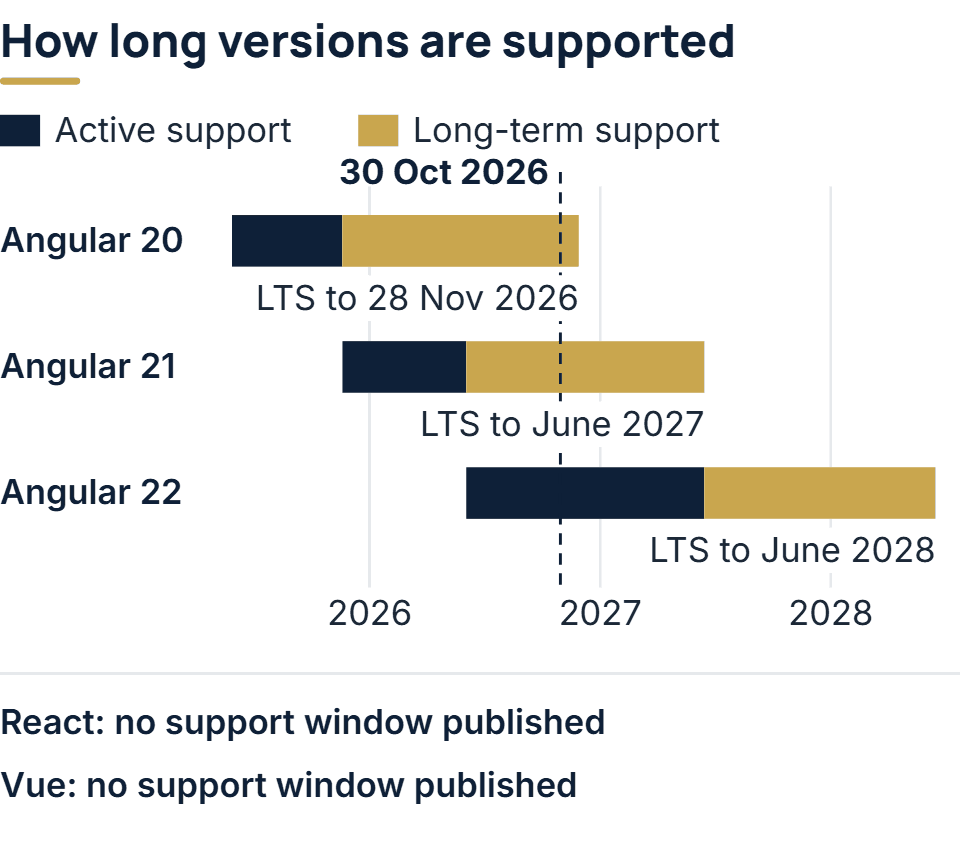
React’s versioning policy follows semantic versioning and sets no schedule for major releases: React 15, 16 and 17 came out in April 2016, September 2017 and October 2020. It states no support window. What it does say is that when the team learns of a security vulnerability, it releases “a backported fix for all major versions that are affected”. That was tested on 3 December 2025, when React disclosed a vulnerability in React Server Components rated CVSS 10.0, the highest score. The fix shipped as React 19.0.1, 19.1.2 and 19.2.1, and Next.js published patched releases across its 14, 15 and 16 lines. Apps whose React code used no server were not affected. For a React app, then, keeping up means following two release policies: React’s and your framework’s.
Vue’s releases page says it “does not have a fixed release cycle”. Minor releases come every three to six months, and deprecated features are removed in the next major. It names no support window either. The one firm date is the end of the last major: Vue 2 reached end of life on 31 December 2023, so any Vue 2 app still running gets no fixes from the Vue team.
Is React or Angular more popular?
React, by a wide margin. In the Stack Overflow Developer Survey 2026, 41.5% of the 10,281 people who answered the question had done extensive work in React over the past year. Vue.js had 17.2% and Angular 16%. Next.js, which is built on React, had 20.6%. The 2025 survey, with 23,678 answers to the same question, had React at 44.7%, Angular at 18.2% and Vue.js at 17.6%, so Vue and Angular swapped places between the two years while both stayed well behind React.
Package downloads point the same way. In September 2026 the npm registry counted 730,634,333 downloads of react, 66,163,256 of vue and 25,267,997 of @angular/core, the package every Angular app installs. Read those with care. A download is an install by a developer, a build server or another package that depends on this one, not an app or a person, and thousands of libraries pull in React. The ratio of about 29 to 1 between React and Angular says more about React’s ecosystem than about how many products use each.
For a business, popularity buys two things: a larger pool of developers to hire from, and more ready-made libraries for common jobs. It does not make one framework faster or better suited to your app.
Is Angular still relevant in 2026?
Yes. Angular 22 came out on 3 June 2026 and is supported until June 2028. 16% of survey respondents had worked extensively in it over the past year, and @angular/core was downloaded about 25 million times in September 2026. The Angular overview names Google Fonts and Google Cloud among the Google products built on it.
Part of the confusion comes from the name. AngularJS, the original framework, is the 1.x line, and Angular’s own releases page treats it as a separate product with its own upgrade guide. The survey counts it separately too: 6% of respondents in 2026. Articles calling Angular dated are often describing AngularJS.
Is Vue for frontend or backend?
Frontend. Vue’s own definition is “a JavaScript framework for building user interfaces”. Vue can render pages on the server, through its server-side rendering APIs or a framework such as Nuxt, so the first view arrives as finished HTML. That is still interface code. Your data, business rules, sign-in and integrations live in a back end, written in whatever language suits it. The same holds for React and Angular.
Why is React better than Angular, and when is it not?
React is the better choice when hiring matters most, when you want to pick each part of the stack yourself, or when the same team will also build native mobile apps, since React’s guide recommends Expo, which is built on React Native, for those. It also suits public-facing products that need server rendering for search, through Next.js or React Router.
Angular is the better choice when many developers will work on the same codebase for years, when the app is mostly forms, tables and workflows behind a sign-in, and when you want one vendor’s release calendar to plan upgrades around. Its conventions cost more to learn and save time once a team is large.
Vue sits between them. It asks less of a new developer than Angular, ships fewer decisions to make than React, and suits a smaller team, or a team adding interactive parts to an existing server-rendered site.
Five questions that settle it
- Who will maintain it in three years? If you have developers, use what they know well. If you will hire, check the local market for each framework before you choose, not after.
- How many developers, and for how long? One or two people on a short-lived tool can use any of the three. A team of ten on a system meant to run for a decade benefits from Angular’s conventions and its published windows.
- Does it need to rank in search or load fast on a first visit? Then plan for server rendering from the start: Next.js or React Router for React, the Angular CLI’s
ng new --ssr, or Nuxt for Vue. An internal tool behind a sign-in usually does not need it. - Will you want native mobile apps too? React Native lets React developers reuse most of what they know, and it is the route React’s own guide points to.
- Who applies updates after launch? Write it into the plan. On Angular, budget one major upgrade a year. On React or Vue, list every framework and library the app depends on and whose releases someone has to watch.
How we choose on a client build
We are not neutral here. Our web application builds use React, Next.js or Angular, written in TypeScript, for the front end, and Vue is not on the list of technologies we count as specializations, so weigh this comparison with that in mind. If you would like a team to make the call with you, the first call is free, and at the end of scoping you receive the scope in writing with a fixed, itemized quote. How the rest of a build runs is set out on the web application development services page.
The full service behind this post: Custom Web Application Development Company.
Ready to scope your project?
Send us two sentences about what you need. We reply within one business day with the next step and any questions we need answered first.