Blog
Types of SDLC models, and how to choose one for your build
SDLC models set the order of the work and when you first see software that runs. Here are the main types and how to pick one for your project.
A software development life cycle (SDLC) model is the plan for the order in which a software project does its work. It answers two questions a buyer cares about more than any diagram: when you first see software that actually runs, and how expensive it is to change your mind once the work has started. Every model contains the same kinds of work. They differ in how that work is sequenced and repeated. This guide covers the types of SDLC models you will hear named in a proposal, what each one is good at, and how to choose between them for your own build.
The phases every model shares
Whatever the model, a project has to settle what the software must do (requirements), decide how it will be built (design), write it (build), check it against what was asked for (testing), put it in front of real users (release), and keep it working afterwards (maintenance). Barry Boehm, writing in IEEE’s Computer in May 1988, put the job of a process model in two questions: what shall we do next, and how long shall we continue to do it? The models below are different answers to those two questions.
Sequential models
Sequential models finish one phase before the next begins. They suit work where the requirements are known early and are unlikely to move.
Waterfall
The waterfall model runs requirements, design, build, testing and operation once, in that order, with each phase signed off before the next starts. It is usually traced to a 1970 paper by Winston W. Royce, “Managing the Development of Large Software Systems”, presented at IEEE WESCON. His second figure shows seven steps in a single descending line, from system requirements to operations. The detail most summaries leave out is what he wrote next: that this implementation “is risky and invites failure”. His reason was that testing comes last, so problems that no analysis could predict surface at the point where fixing them can force a redesign. The paper then adds five features to the sequence, among them doing the job twice if possible and involving the customer.
Waterfall still has a place. When the scope is fixed by a contract or a regulation and the cost of a late change is high, a single pass with clear sign-offs is easy to plan and easy to audit. The price is that you see working software late.
V-model
The V-model keeps the sequence but pairs each stage on the way down with a check on the way up. Requirements are matched by acceptance testing, the system design by system testing, the detailed design by integration testing, and the code by unit testing. Drawn out, the stages form a V. The pairing means each check is planned at the moment its stage is written, which is why the V-model is common where every requirement must be shown to have been verified.
Iterative models
Iterative models go round the cycle more than once, so the software grows and improves with each pass.
Iterative and incremental
The team builds a small part of the product, lets people use it, and then builds the next part with what was learned. Each increment adds to a version that already works. This suits products where the core is clear but the details are not, and it lets you stop at any increment with something usable.
Spiral
Boehm’s spiral model, from the same 1988 paper, is driven by risk. He described it as a risk-driven approach, in contrast to processes driven by documents or by code. Each turn of the spiral starts by setting objectives, alternatives and constraints, then evaluates the alternatives to identify and resolve risks, often with a prototype, then develops and verifies the next level of the product, and ends by planning the next turn. The cumulative cost grows with each turn. It fits large or unfamiliar work where the biggest danger is building the wrong thing well.
Prototyping and rapid application development
A prototyping model builds a throwaway version early to answer one question, such as whether a workflow makes sense to its users or whether an integration is possible at all. Rapid application development leans on prototypes and quick user feedback to shorten the time to a first working system. Both overlap with how early-stage products are scoped. If you are weighing a proof of concept against a prototype or a first release, our MVP page sets out how a POC, a prototype and an MVP differ.
Agile
Agile is not a single model but a set of values. The Manifesto for Agile Software Development, published in 2001, puts individuals and interactions, working software, customer collaboration and responding to change ahead of the things it is weighed against. Two frameworks carry most agile work in practice.
Scrum
The Scrum Guide, by Ken Schwaber and Jeff Sutherland (current version November 2020), defines Scrum as a lightweight framework. Work happens in Sprints of one month or less. Each Sprint contains Sprint Planning, a Daily Scrum, a Sprint Review and a Sprint Retrospective, and the guide names three accountabilities: Developers, a Product Owner and a Scrum Master. A Scrum Team is typically 10 or fewer people, and our piece on building a software development team works through why that limit matters when you hire. The Sprint holds all the other events, and its work produces an Increment: in the guide’s terms, a concrete stepping stone toward the Product Goal, which must be usable.
Kanban
Kanban usually runs without fixed iterations. Work items move across a board of columns, from waiting to done, with a limit on how many can sit in progress at once. Items are released when they are ready, without waiting for the end of a time box. It suits a steady flow of smaller changes, such as the work on a product that is already live.
How to choose an SDLC model
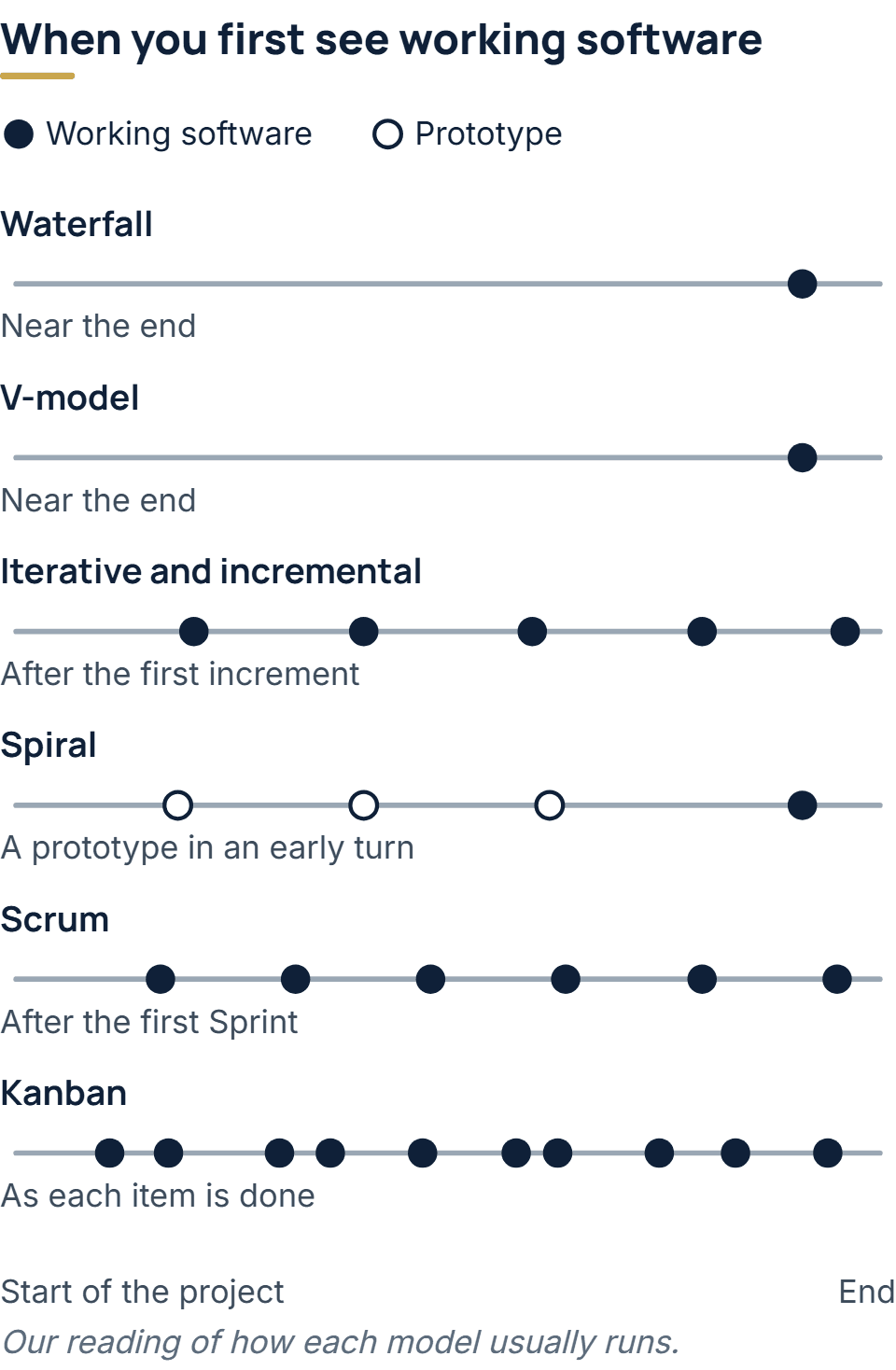
Start from what you know about the project, not from the name of the model. The table below lines up the questions that usually decide it.
| Model | Best when | First working software | Cost of a late change |
|---|---|---|---|
| Waterfall | Scope is fixed by contract or regulation | Near the end | High |
| V-model | Every requirement must be shown to be verified | Near the end | High |
| Iterative and incremental | The core is clear and the details are not | After the first increment | Moderate |
| Spiral | The work is large, new or risky | A prototype in an early turn, working software later | Moderate, and planned for |
| Scrum | Requirements will change as users react | After the first Sprint | Low |
| Kanban | A live product needs a steady flow of changes | As each item is done | Low |
The columns are our reading of how each model usually runs, not a rule from any of the sources above.
Most real projects mix models. A system built for a regulated buyer may fix its requirements and audit trail up front, as the V-model does, and still deliver in short iterations. That pattern is common in enterprise software development, where the scope and the sign-offs are agreed before the build but users still need to see the system early. A new product sold to many customers usually needs the opposite balance: a small set of decisions settled early and everything else left open to learning.
How a Devrisen build runs
Here is the sequence on our builds. Scoping ends with a written scope document, and the fixed, itemized quote is built from it. On a website build, the designs are approved as clickable pages before the build starts. While the build runs there is a working demo every week. On an MVP, scoping takes about a week and the build runs in two-week sprints, with a demo every week. At launch you receive a documented handover pack covering hosting, code, accounts and documentation.
In the terms of this guide, that is iterative delivery with the scope written down first. For a product that will serve many customers, our SaaS development process shows which decisions are settled before the build starts and what each weekly demo covers from then on.
The full service behind this post: SaaS Development Company & Services.
Ready to scope your project?
Send us two sentences about what you need. We reply within one business day with the next step and any questions we need answered first.