
Blog
IT staff augmentation: how it works and what to check first
IT staff augmentation adds outside engineers to your team under your own lead. How the model works, when it fails, and the contract and access checks to make.
IT staff augmentation is a way of adding engineers to your team without hiring them. A vendor employs the developers, testers or DevOps engineers, and you bring them into your own team for a set period. They work on your backlog, in your tools, under your technical lead, and the vendor bills you for each person, usually by the hour or by the month. You get extra capacity or a missing skill in weeks rather than after a hiring round. What you do not get is anyone else managing the work. That stays with you, and so do most of the risks.
How IT staff augmentation works
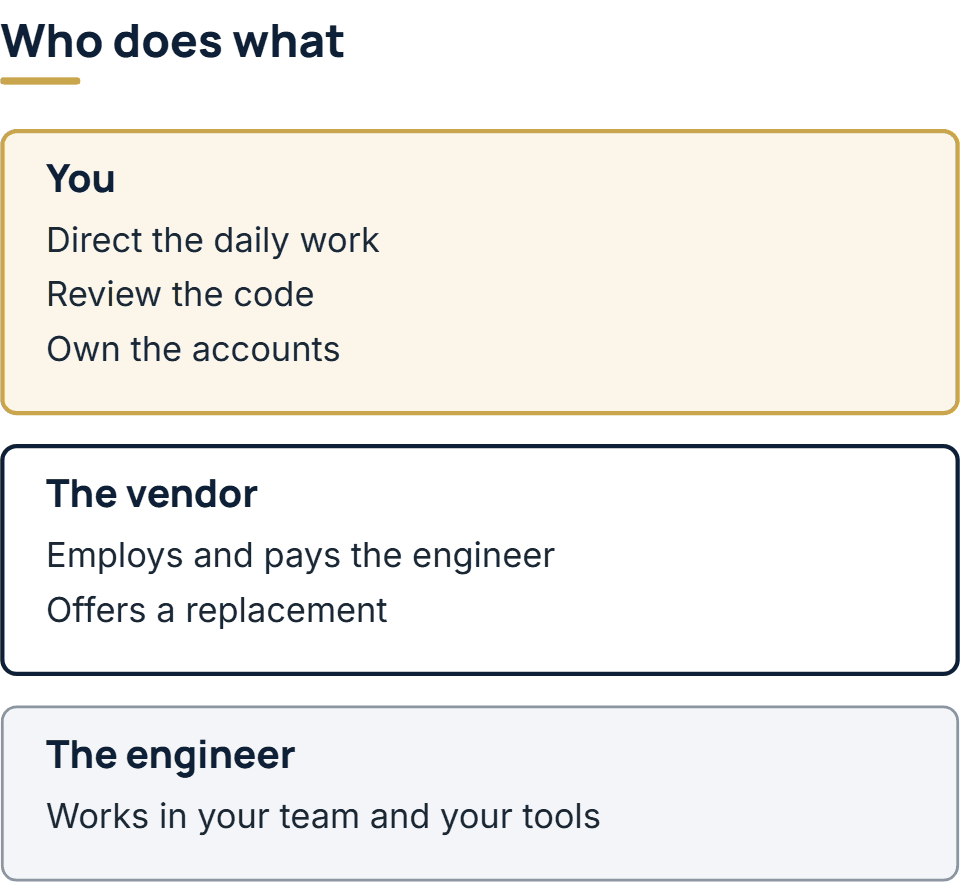
Three parties are involved. You direct the daily work, review the code and own the accounts the engineer logs into. The vendor employs the engineer, pays them and usually offers a replacement if the placement does not work out. The engineer works in your team and your tools, joins your meetings and commits to your repository, while staying on the vendor’s payroll.
A typical engagement runs in six steps:
- Write the role. Name the skill, the seniority, how many hours must overlap with your team’s day, and how long you expect to need the person. “A senior React developer, four hours of overlap with New York, six months” brings better candidates than “a developer”.
- The vendor shortlists. It sends profiles of engineers it employs or can engage.
- You interview. Give the candidates the same technical interview you would give a hire. You are choosing a person, not a company, and the person decides how the placement goes.
- Sign the contract. Rate, billing unit, minimum term, notice, replacement and ownership of the code, all covered below.
- Onboard. Accounts, access, a walk through the codebase and a small first task. Expect the first weeks to be slower than the rest.
- Roll off. Knowledge written down, access removed on the last day, and any open work handed to someone who stays.
What is a staff augmentation role?
Seen from the engineer’s side, a staff augmentation role is a job with one company and a desk, real or remote, in another. The vendor employs or contracts the engineer and pays them. The client’s lead assigns their tasks and reviews their work. The roles placed this way are mostly the ones a software team uses every day: developers, QA engineers, DevOps and cloud engineers, data engineers and designers. A placement usually lasts months, and when one ends the engineer moves to the vendor’s next client. Pay for the role is agreed between the engineer and the vendor, not with you.
Because the engineer answers to two organizations, settle early who approves time off, who reviews their performance and who they turn to when two priorities clash. The workable split is that your lead decides what the engineer works on and the vendor handles everything about the employment.
What does IT staffing mean?
IT staffing is the wider business of supplying technology workers to companies, and staff augmentation is one form of it. The three forms you will meet differ in who ends up employing the person:
| Form | What you get | Who employs the person | How long it lasts |
|---|---|---|---|
| Contract staffing (staff augmentation) | An engineer working inside your team | The vendor | A set term, often months |
| Contract-to-hire | An engineer on contract first, with the option to hire them | The vendor, then you if you take the option | A trial term, then permanent |
| Direct hire | A recruiter finds a candidate for your payroll | You, from the first day | Permanent; the recruiter is paid a fee |
The middle row matters even if you only plan to augment. Many augmentation contracts stop you hiring the vendor’s engineer yourself, or charge a conversion fee if you do. If there is any chance you will want to keep the person, read that clause before you sign.
Staff augmentation vs outsourcing
The difference is who manages the engineers and who pays when the work overruns its estimate. Under staff augmentation you manage them, and you pay for every hour they work, including the hours a wrong estimate adds. Under a fixed-scope project the vendor manages its own people against a written scope and carries the overrun. A dedicated team, sometimes sold as a managed service, sits between the two: the vendor runs the team and your product owner sets its priorities. The three models are laid out side by side, with how each is priced, in our guide on whether to build in-house or outsource.
A quick test helps. If you can name the person on your side who will give the outside engineers their tasks every day and review their code, augmentation can work. If nobody comes to mind, what you need is a team that manages itself, and that is outsourcing.
When staff augmentation works, and when it does not
It tends to work when:
- You already have a technical lead with time to direct more people.
- The backlog is clear enough that a newcomer can finish a task in their first week.
- You need a skill for a limited stretch of work, such as a cloud migration, a first mobile release or a backlog of security fixes.
- A fixed date needs more hands, and the work splits into pieces people can take on in parallel.
It tends to fail when:
- Nobody can lead. Engineers who take direction need someone to give it. Without that person you pay for capacity that sits waiting.
- The project is already late. Fred Brooks argued in The Mythical Man-Month (1975) that adding people to a late software project makes it later, because newcomers have to be trained and every extra person adds lines of communication. Add people early, or cut scope instead.
- The work is the core of the system. If the outside engineer designs the part everything else depends on, that knowledge walks out at the end of the contract. Keep that work with your own staff, or pair one of them with the outside engineer throughout.
- The term is very short. Onboarding costs the same whether the placement lasts three weeks or a year, so a short placement can end just as the person becomes fully useful.
What staff augmentation costs
Vendors bill for each person by the hour, the day or the month. That rate pays for the engineer’s salary and benefits and also for the vendor’s recruiting, equipment, management and margin. So compare it with what an employee would cost you in total, never with a salary alone.
Several costs fall on your side and appear on no invoice:
- Your lead’s time, spent on interviews, onboarding, daily direction and code review.
- The ramp-up, the weeks of partial output while the person learns your codebase.
- Seats and licenses for each extra person: development tools, design tools, cloud, monitoring and ticketing accounts.
- The handover at the end, when someone on staff has to take over the work.
The ramp-up is why term length matters so much. Assume, for illustration, that a new engineer works at half speed for their first three weeks. That loses the equivalent of a week and a half. On a six-month placement of 26 weeks, that is about 6% of what you pay for. On a three-month placement of 13 weeks, the same ramp-up is about 12%, before you count any of your lead’s time.
Contract terms to check
- Rate and billing. Hourly, daily or monthly; what counts as billable time; how hours are reported and who approves them; whether overtime is allowed and at what rate.
- Minimum term and notice. How early either side can end the placement, and whether the vendor can move your engineer to another client before the term ends.
- Replacement. What happens if the engineer is a poor fit or resigns: how quickly the vendor must put forward a replacement, and who pays while the new person learns the work.
- Ownership of the code. Under US copyright law, the copyright in a work made for hire belongs to the employer or other person for whom the work was prepared (17 U.S.C. § 201(b)). The statute does not say which company that is when the vendor pays the engineer and your lead directs the work, so do not assume the code is yours because your team gave the instructions. A transfer of copyright is valid only in a writing signed by the owner of the rights (§ 204(a)), so the contract has to assign the code to your company. Work by a freelancer the vendor engages counts as made for hire only in the narrow categories that section 101 lists, and only with a signed agreement, so ask the vendor to hold a written assignment from each person it places and to pass the rights on to you.
- Confidentiality and data. A confidentiality clause that binds the engineer as well as the vendor. If the engineer will handle personal data and the EU or UK GDPR applies to you, add the processor contract described in our in-house vs outsourcing guide.
- Hiring the engineer. Whether you may employ the person later, after how long, and for what fee.
Employment rules that can reach you
The engineer is the vendor’s worker, but the rules on who counts as an employer can still land on your side.
- United States. The IRS sorts workers into employees and contractors by looking at who controls the work, who controls the money side of it, and how the two parties set up and treat the relationship. An augmented engineer takes direction from your lead, which points toward the first of those. Ask the vendor whether each engineer is its own employee or a contractor it engages. The IRS weighs the whole relationship, so the vendor’s label does not settle the question, but your lawyer or accountant should see that answer before the contract is signed.
- United Kingdom. When a worker provides services through their own intermediary, usually a limited company, the off-payroll working rules (IR35) can apply. Since 6 April 2021, a medium or large client in the private or voluntary sector decides whether they apply, and must pass a status determination statement with its reasons to the worker and to the party it contracts with, as HMRC’s guidance sets out. If you contract with the worker’s own company directly, you are the deemed employer: you deduct Income Tax and employee National Insurance from the fees and pay the employer’s National Insurance on top. So ask how each engineer is engaged. One on the vendor’s payroll is outside these rules. One working through their own limited company, even when the vendor supplies them, makes the status decision yours if your company is medium or large; which party in the chain then acts as deemed employer depends on the contracts between you. HMRC’s guidance also says that a client receiving a contracted-out service, where the vendor runs the work, does not have to apply these rules itself; that duty passes to the vendor.
- Anywhere else, take local advice before the first placement. The rules vary by country.
Onboarding and offboarding outside engineers
Access is the part most easily left loose. NIST’s catalog of security and privacy controls, SP 800-53, which US federal agencies are required to use, has a control for exactly this case. PS-7, External Personnel Security, asks an organization to require outside providers to follow its personnel security policies and to tell it when their staff who hold credentials or system privileges transfer or leave. PS-4, Personnel Termination, covers the day someone leaves: disable their system access, revoke their credentials, retrieve the equipment and keep access to the information they controlled. You do not need to be a federal agency to borrow that list:
- Named accounts. Give each engineer their own account in your systems, in your company’s identity provider if you have one, and never a shared login.
- Least access first. Start with what the role needs, such as the repository, the ticket tracker and a test environment. Add production access only when the work calls for it, and log it.
- Notice in the contract. The vendor tells you the same day an engineer is moved off your account or leaves.
- The last day. Remove the accounts, revoke keys and tokens, rotate any shared secret the person could see, and collect any equipment you issued.
- Work that stays. Commits go to your repository and decisions go into your tickets or documents, never only into the engineer’s own notes. In the last two weeks, have them walk an employee through what they built.
When you need a team rather than individual engineers
If the person on your side who would direct outside engineers does not exist yet, a team that runs its own work suits you better, and that is a model Devrisen offers. A dedicated team from us has a fixed monthly fee agreed before it starts, and a build whose scope can be written down gets a single fixed price after scoping. You see the software working in a demo every week, and every contract we sign transfers the code and the IP rights to your company. More about what we build is on the home page of Devrisen, a custom software development company. Or send us the project you have in mind, and our reply will reach you within one business day.
More about us: Custom Software Development Company.
Ready to scope your project?
Send us two sentences about what you need. We reply within one business day with the next step and any questions we need answered first.