
Blog
In-house vs outsourcing software development: how to decide
In-house vs outsourcing software development compared on cost, control and speed, with BLS pay data, the ways to outsource and what to keep in your hands.
In-house software development means the people writing your code are your own employees. Outsourcing means paying another company, or independent contractors, to write it for you. Neither one is cheaper in every case. Hiring tends to pay off when the work has no end date, the software is what your business sells, and someone on your payroll can lead engineers. An outside team usually fits better when the work has a finish line, needs a skill you will not use again, or has to start before you could recruit anyone. Most companies end up somewhere between the two, and the part worth deciding carefully is what stays in your hands either way.
The two options side by side
| In-house team | Outsourced team | |
|---|---|---|
| Who employs the developers | Your company | The vendor, or the contractors themselves |
| Who directs the daily work | Your own lead | You or the vendor’s lead, depending on the model |
| How the cost behaves | Mostly fixed: salaries and benefits continue between projects | Follows the contract: by the hour, by the month or per agreed scope |
| How soon work can start | After recruiting and onboarding | Once a contract is signed and the team is briefed |
| What remains when the work ends | The people and what they know | The code and documents, if the contract hands them over |
| Who pays when work runs long | You | Set by the contract: you under hourly billing, the vendor under a fixed price |
What an in-house developer costs
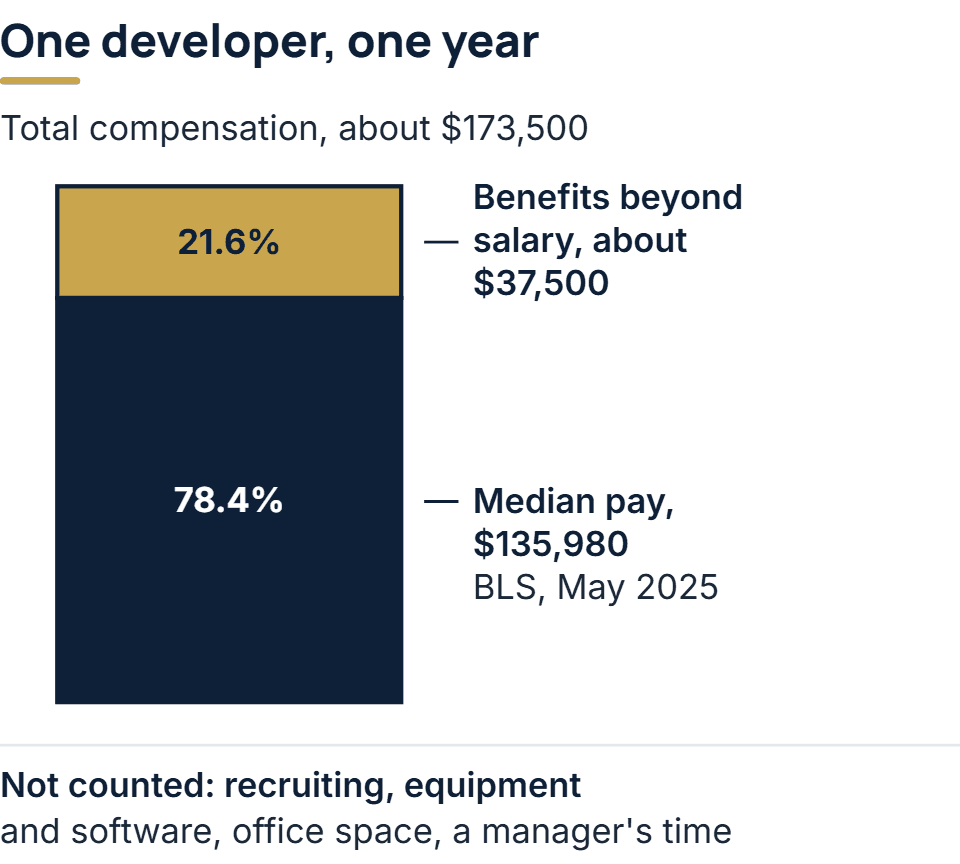
The US Bureau of Labor Statistics gives the median annual pay of software developers as $135,980 in May 2025, in its Occupational Outlook Handbook. Pay is only part of what an employer spends. In the BLS Employer Costs for Employee Compensation release for June 2026, wages and salaries were 69.2% of compensation costs for professional and related workers in private industry, and benefits were the other 30.8% (table 4). Benefits in that series include paid leave, bonuses, insurance, retirement plans and legally required payments such as the employer’s share of Social Security and Medicare. One of those, paid leave, is already inside an annual salary, since a salaried developer is paid for vacation days; it is 9.2% of compensation in the same table. What still has to be added is the remaining 21.6% of total compensation, which comes to about 27.6% on top of the salary itself.
Applying that share to the median salary gives a rough yearly figure for one developer:
| Item | Amount | How it is worked out |
|---|---|---|
| Median pay | $135,980 | BLS, software developers, May 2025 |
| Benefits beyond salary | about $37,500 | 21.6% of total compensation |
| Total compensation | about $173,500 | $135,980 ÷ 0.784 |
Even that total is short of what a hire really costs. It leaves out recruiting fees, laptops and software licenses, office space, and the hours a manager puts into hiring and leading. It is also a national median, and the benefit share covers professional workers as a group rather than developers alone, so replace both with your own salary offer and benefit costs. Few products are built by one person. Design, testing and code review are usually separate jobs, so multiply by the size of the team you would actually employ.
What outsourcing costs
Vendors price their work by the hour or day, as a monthly fee for a team, or as one fixed price for an agreed scope. Whatever the form, a vendor’s rate already pays for its own salaries, benefits, equipment, management and margin. Compare it with the total compensation figure above plus your own overheads, never with a salary on its own.
Some costs land on your side under any contract. A person in your company has to make product decisions, answer questions and accept finished work, and that takes hours every week. The work also needs a written scope, because a loose brief turns into change requests under any pricing. How a scope becomes a number is the subject of our software development cost estimation guide.
Three ways to outsource the work
Outsourcing arrangements differ mainly in who manages the engineers and who carries the cost if the work takes longer than planned. If you have met the phrase “staff aug vs managed services”, it is the first row of this table set against the other two.
| Model | Who manages the work | How it is usually priced | It fits when |
|---|---|---|---|
| Staff augmentation | You. Outside engineers join your team and take direction from your lead | Per person, by the hour or month | You already have an engineering lead and need extra capacity or one missing skill |
| Dedicated team | The vendor runs a team that works only on your product, while your product owner sets priorities | A monthly fee for the team | The work is ongoing but you do not want to build an engineering department |
| Fixed-scope project | The vendor, working to a written scope | One price for that scope | What has to be built can be written down before work starts |
Hiring freelancers directly, rather than through a company, raises a question of classification. The IRS decides whether a worker is a contractor or an employee from evidence of behavioral control, financial control and the type of relationship. A contractor who keeps your hours, takes your direction and uses your equipment can look like an employee. If the status is unclear, either side can file Form SS-8 to have the IRS decide, and the IRS says its ruling can take six months or more.
When in-house is the better choice
Hiring makes most sense when the software is the business. If you sell the product, change it weekly and expect to keep doing so for years, knowing why the code is built the way it is becomes an asset, and that knowledge is safer inside the company. The case is similar for work that depends on daily contact with users or other departments, such as internal tools that change with every new process.
You also need someone who can recruit and lead engineers. A first developer hired with no technical lead above them has nobody to review their work, and a poor early hire is expensive to unwind. Expect competition for candidates as well: BLS projects employment of software developers, quality assurance analysts and testers to grow 10% between 2025 and 2035, which it rates as much faster than average.
Check your obligations, too. A customer contract or your own security policy may say that only employees may handle certain data, which settles the question for that work.
When outsourcing is the better choice
An outside team suits work that ends: a first version to test demand, a move off an old system, an integration between two products. It also suits a skill you need for months rather than years, such as a first mobile release, and work that has to begin sooner than a hiring round would allow.
For a company with no engineers yet, outsourcing is often the lower-risk start. A vendor arrives with its own lead, code review and testing already in place, which a single first hire cannot supply. That holds only if you keep the decisions and the access, as set out below.
Why US companies outsource software development
The reasons are the ones above. A developer costs about $173,500 a year once benefits are counted, hiring takes months, and many skills are needed only for one project. Time zones are a further reason for some, since a team working ahead of US hours can finish work overnight and have it ready for review in the morning. Outsourcing does not remove the need to manage. A team that is briefed loosely or reviewed rarely costs more than its rate suggests, wherever it is based.
What to keep in-house even when you outsource
Whichever model you pick, these stay with your company:
- Product decisions. One person on your side owns the priorities and signs off finished work. A vendor can advise, but it cannot decide what matters most to your business.
- Accounts and access. Register the code repository, hosting, domain, app store listings and third-party services in your company’s name, and add vendor staff as users you can remove.
- Ownership of the code, in writing. Under US law, code a contractor writes is not automatically the client’s, so the contract has to transfer it. Our guide to choosing a software development company lists the clauses to ask for.
- A data processing contract. If your company falls under the EU or UK GDPR and the vendor will handle personal data on your behalf, Article 28 (UK text) requires a contract (or other binding legal act) with the processor. It also bars the processor from bringing in another processor without your prior written authorization, so ask who the subcontractors are.
- Documentation and a handover clause. Ask for architecture notes and a runbook as the work proceeds, and agree in the contract how the work passes to your own staff or to another vendor.
The mix most companies settle on
A common pattern keeps a product owner and a technical lead on staff and uses an outside team for build capacity. What to build, and why, stays in the company, while the number of people writing code can rise and fall with the work. Another pattern starts with an outside team for the first version and hires once the product has proved itself, with the vendor handing over to the new staff. If that second path is the plan, put the handover in the first contract, including a stretch of weeks when both teams work on the code together. When the time comes to hire, our guide to building your own software team covers the roles to fill first and how big each team should be.
If you choose to outsource to us
Devrisen works from Islamabad and Melbourne, and on every working day one of us is online with the US East Coast, Australia and New Zealand, the Middle East, and the UK and Europe. We quote a build as one fixed price once scoping is done, and a dedicated team as a fixed monthly fee agreed before work begins. Either way, you watch the software run in a demo each week. Every contract we sign assigns the code and its intellectual property to you. Read more about Devrisen as a custom software development company, or write to us and hear back within one business day.
More about us: Custom Software Development Company.
Ready to scope your project?
Send us two sentences about what you need. We reply within one business day with the next step and any questions we need answered first.