
Blog
Software development cost estimation: methods and a worked example
How software development cost estimation works: size, effort, the main methods, and a worked three-point example that shows why one number is never enough.
Software development cost estimation works in a fixed order. First you measure how big the software is, then you turn that size into the effort needed to build it, and only then do you turn effort into a cost and a schedule. So when someone asks what software costs to develop, the honest answer is a method rather than a figure. A sound estimate comes out as a range, with the assumptions behind it written down, because a single number hides how likely it is to be wrong. Below are the steps, the main methods, and a worked example you can copy.
How is software development cost estimated?
The US Government Accountability Office (GAO) sets out best practice for federal programs in its Cost Estimating and Assessment Guide. Its appendix on software puts software estimation on two foundations: how big the software will be, and how much effort it takes to build. Size and complexity are what drive the cost.
Size comes first. Teams measure it in several ways: function points, the COSMIC functional size method, source lines of code, or use cases. GAO’s test for any of them is simple. Two people who apply the same counting rules to the same problem should arrive at similar answers.
Effort comes from size divided by a productivity figure, such as the function points a team delivers per work month. That figure should come from past projects like this one. When there are none, an industry benchmark can stand in, but it makes the result less certain.
Effort becomes money once it is multiplied by the people’s rates, and the cost does not stop at code. GAO counts testing before launch, infrastructure and services, and maintenance after launch as part of the software’s life cycle cost, and says rework belongs in every schedule, since software is unlikely to ship with no defects at all. One more trap: code you plan to reuse or adapt usually takes more work to fit in than expected.
The main estimation methods
GAO compares three core methods and names a few more. Most real estimates use one as the main method and a second to check it.
| Method | How it works | Strong when | Weak when |
|---|---|---|---|
| Analogy | Start from what a similar past project actually cost, then adjust for the differences | Little is known yet; you need a rough figure fast | The past project is not really similar; the adjustments are guesses |
| Bottom-up (engineering build-up) | Split the work into small parts, estimate each one, add them up | The design is detailed; you need an audit trail or a basis for negotiation | Early on, before the parts are known; it is slow |
| Parametric | Feed size and other factors into a model built from many past projects | You need a budget figure early or an independent cross-check | Nobody understands what the model does inside; GAO notes commercial tools are often black boxes |
| Expert judgment | People who have built similar systems give their view | Nothing else is available | Ranges come out too narrow (see the example below) |
| Relative sizing | An agile team compares items with each other, in points | The estimate is refined every iteration | You compare points across teams or suppliers |
GAO recommends sizing the software with two different methods and looking at where they agree. An estimate that has only ever been worked out one way has not been tested.
A software development cost estimation example
Here is a bottom-up estimate for a small customer portal, using three-point estimates, the method GAO describes: for each part, a minimum, a most likely and a maximum. The figures are invented for illustration, drawn from no project of ours, and they are in person-days rather than money.
| Part | Minimum | Most likely | Maximum |
|---|---|---|---|
| Sign-in and user roles | 4 | 6 | 10 |
| Customer dashboard | 8 | 12 | 20 |
| Link to the accounting system | 6 | 10 | 25 |
| Admin screens and reports | 6 | 9 | 15 |
| Import from the old system | 3 | 5 | 15 |
| Total | 27 | 42 | 85 |
The obvious answer is 42 days, the sum of the most likely column. It is also the number most likely to be wrong. Look at the shape of each row: the maximum sits much further above the most likely figure than the minimum sits below it. Here the accounting link and the import are the most lopsided, because more can go wrong with them than can go unexpectedly well.
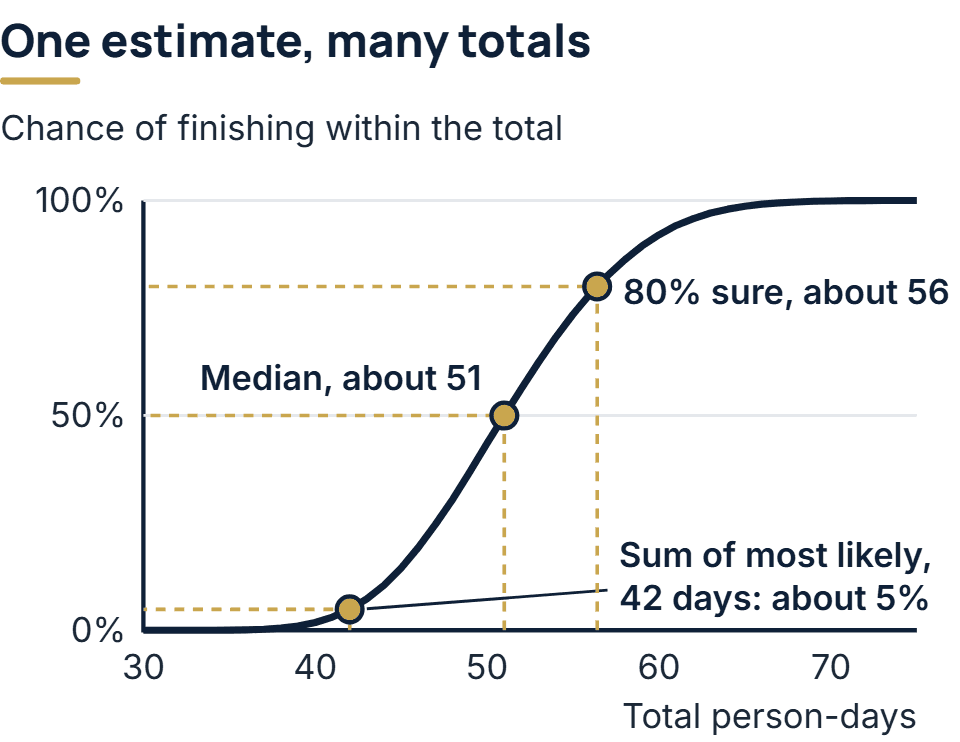
We ran the table through a simple simulation: 100,000 trial projects, each part drawn at random from a triangle between its three figures (the shape GAO says risks are usually modeled with). The results:
- The chance of finishing within 42 days is about 1 in 20.
- The median, the total with an even chance of being beaten, is about 51 days.
- To be 80 percent sure, plan for about 56 days.
So the 42-day plan needs roughly 14 more days to reach a level of confidence most buyers would accept. And the inputs were probably too kind. GAO notes that the ranges experts give have been shown to cover only 60 to 85 percent of the possible outcomes, which is why estimators sometimes widen them.
To turn days into a cost, multiply by the day rate of the people doing the work. That rate is the supplier’s to state, and it is not part of this example.
Why one number is not enough
GAO’s guide is blunt here: a point estimate on its own tells you nothing about how uncertain it is, and it is not enough to make good decisions with. Because large overruns are more likely than large savings, the average outcome usually sits above the median. The S-shaped curve in the example is how estimators show this. Each point on it pairs a total with the chance that the total will be enough.
Which point on the curve to budget at is a choice the buyer makes. GAO says no confidence level counts as best practice; budgeting to the average is common, and for high-risk work it describes planning at 70 or 80 percent. The gap between the single-number estimate and the level you pick is the contingency.
Many estimating problems trace back to optimism about the inputs, GAO says, and it gives two examples. A plan that expects 100,000 lines of code and ends at 200,000 is underestimated. So is a plan that counts on reusing 80,000 lines from an old system and manages 10,000.
Under a fixed price, the supplier carries the cost if the work runs over, so the range does not go away; it moves to the supplier’s side of the contract. Comparing suppliers on contract type shows what that means for you.
What a reliable estimate shows you
GAO defines a reliable estimate by four characteristics. Each one turns into a question you can put to anyone who hands you an estimate.
- Comprehensive. Does it cover the whole system, with each part counted once? Are the assumptions and the exclusions listed, so you can see what is not in the number?
- Well documented. Could someone else repeat it? It should say which method produced each figure and where the data came from.
- Accurate. Is it based on what comparable projects actually cost, and is it updated when the work changes? An estimate nobody revises stops being one.
- Credible. Does it state its limits and show how much the total moves when a major assumption changes? Does it give a range, or a confidence level, rather than one figure?
GAO also expects the biggest cost items to be cross-checked, with a second method producing a similar answer.
Every one of these depends on a written scope. An estimate can only count the parts someone has described, which is why the SRS document template comes before the quote.
Estimating agile work
Agile teams usually size work relatively. They compare backlog items with each other and score them in points, rather than estimating hours from scratch. The Scrum Guide is clear on who does it: the developers who will do the work size it, and the product owner helps them understand the trade-offs.
The advantage, GAO notes, is that an agile estimate can be refined at the end of every iteration, and in Scrum each sprint lasts a month or less, so the estimate improves as you learn. The catch is that points mean different things on different projects, and even on two teams working on the same program. One supplier’s points need not mean what another’s do, so ask what a point has meant on their past work.
How we price a build
You will not find a rate card or a price band on our site. Talking through the project costs you nothing, and neither does scoping a new build. If the new software has to work with old code, or with several of your current systems, we begin with a short assessment, which is paid. Paid build work begins only once you have our fixed quote, broken down part by part from the agreed scope document, so you can drop a part or push it to a later phase first. Here is how we turn a written scope into a fixed quote.
The full service behind this post: Software Development Cost: How a Quote Is Built.
Ready to scope your project?
Send us two sentences about what you need. We reply within one business day with the next step and any questions we need answered first.