
Blog
How to choose a software development company: what to check
Five checks before hiring a software development company: the problem on paper, the contract type, real work, a small first step, and owning the code.
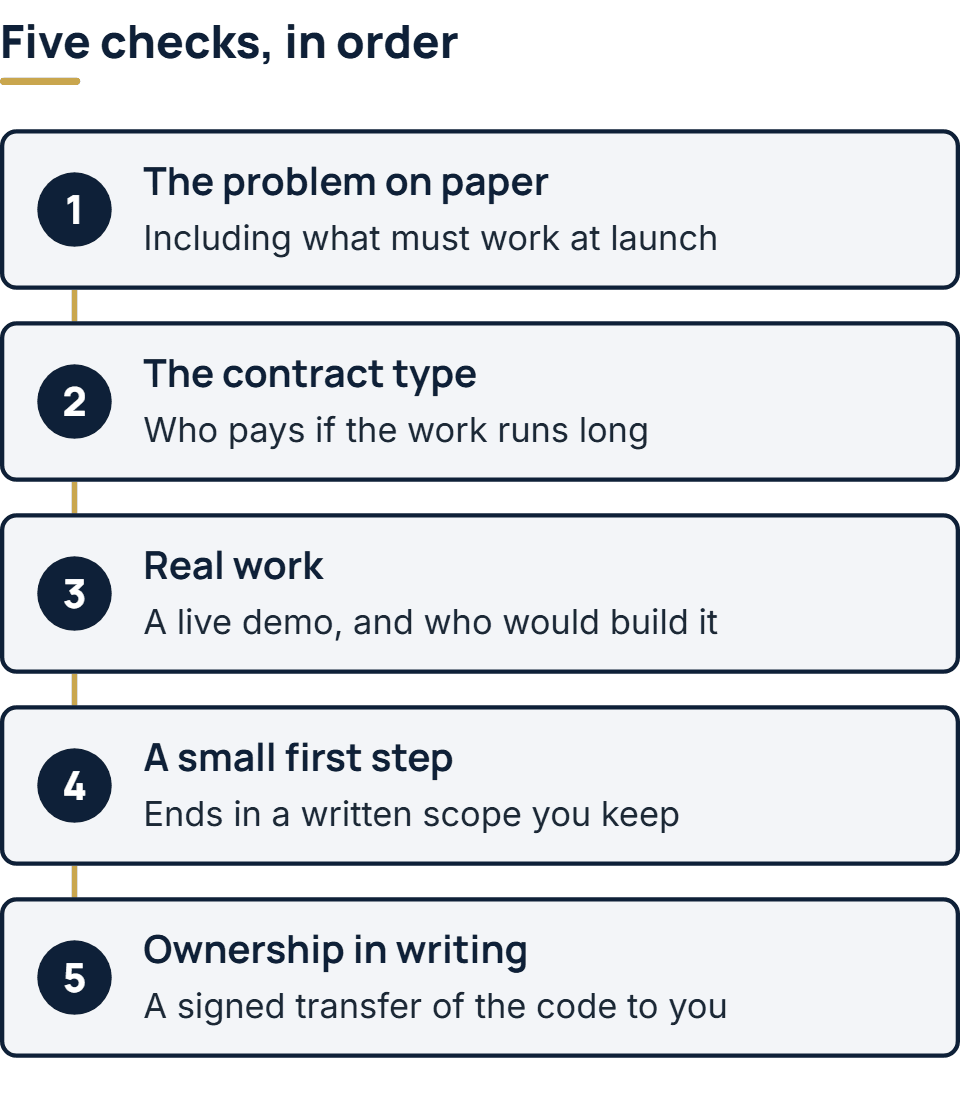
Choosing a software development company comes down to five checks, made in order. Write the problem down before you talk to anyone. Pick the contract type that puts the cost risk where you want it. Judge each company on work you can see. Start with a small first step. Then get ownership of the code in writing, because under US law it does not pass to you on its own.
Still deciding whether to hire a company at all, or to employ developers of your own? Our comparison of in-house vs outsourcing software development works through the costs and the trade-offs first.
Write down the problem before you contact anyone
Companies answer the brief they are given. Send five of them a one-line idea and you get five quotes for five different products, with no fair way to compare them.
A page or two is enough to start. Say what problem the software solves and for whom, which kinds of user will sign in, which systems it has to connect to, whether the data falls under any rules, and what has to work on the day it goes live. Then mark what can wait for a later release. That last list is where quotes differ most, so it is worth the most thought.
If you want more structure, our SRS document template gives the headings and a filled example. The draft does not have to be right. A good company will question it, and the way it questions your draft is your first real look at how it works.
Fixed price or time and materials: who carries the risk
The contract type decides who pays when the work takes longer than planned. The US Federal Acquisition Regulation defines both plainly, and the definitions describe a private contract just as well.
Under a firm-fixed-price contract, the price does not move with what the work actually costs the contractor, who carries full responsibility for those costs and the resulting profit or loss (FAR 16.202-1). A time-and-materials contract pays hourly rates for the hours worked, plus materials at cost. The regulation allows it only when the extent or duration of the work cannot be estimated accurately, requires a ceiling price, and notes that it gives the contractor no profit incentive to control cost, so the buyer has to watch the work closely (FAR 16.601).
| Fixed price | Time and materials | Team on a monthly fee | |
|---|---|---|---|
| You pay | One agreed price for an agreed scope | Hourly rates for the hours worked, plus materials | A set fee each month |
| If the work runs long | The company absorbs it, for the agreed scope | You pay, up to any ceiling | You decide what the team does next |
| Suits | Work you can describe fully up front | Work whose size cannot be estimated yet | A roadmap that keeps moving |
| Your part | Agree on the scope in writing first | Track progress and set a ceiling | Set priorities every cycle |
A fixed price is only as good as the scope behind it. A company that names one before it understands your scope is guessing, and the guess comes back later as padding or as arguments over every change. Any honest estimate is a range, and our walk-through of software cost estimation methods shows how wide that range can be on a small build. We offer the first and the third of these, and we do not charge by the hour. Our cost page explains how a build gets its fixed price and how a team is billed.
Ask to see real work
Almost every company’s website, ours included, says its engineers are senior, and most say their process is agile. A website is easy to write. Evidence is harder to produce. The US government’s TechFAR Hub tells its buyers to evaluate demonstrated experience, which can include a sample of code the vendor wrote and the results of that code, and to consider oral presentations to find out whether a vendor truly knows agile development.
You can run the same checks at a smaller scale:
- Ask for a demo of software the company built and still runs, and ask what they would change in it now.
- Ask who would do your work, and have those people walk you through how they would start, not only a salesperson.
- Ask what you would see each week, and whether you get access to the issue tracker and the code repository from the first day. The US Digital Services Playbook lists both, alongside version control and code review, as basic delivery practice.
- Call a reference and ask what went wrong on their project and what the company did about it. Every project has a bad week, and the answer shows you how this company behaves in one.
Start with a small first step
Before you commit to a whole build, agree on a small piece of work that ends in something you keep: a written scope, a prototype of the riskiest screen, or an assessment of code you already have. The GOV.UK Service Manual has a name for the first of these, discovery. Its rule is to understand the problem before you commit to building, and not to start building during discovery. It says there is no set length, but around 4 to 8 weeks is typical, and that stopping at the end is not a failure if the research shows stopping is right.
A first step is small next to the cost of a wrong build, and it is the best trial of working together you can get. You see how the company asks questions, how it writes things down, and whether it tells you what to leave out.
Who owns the code when the work is done?
Most guides say to make sure you own the intellectual property. Under US law there is a specific reason: ownership does not pass to you just because you paid for the work.
Copyright belongs first to the author of a work (17 U.S.C. §201). The exception is a work made for hire. The US Copyright Office’s Circular 30 gives two routes to that status: an employee creates it as part of the job, or a commissioned work falls in one of nine listed categories, such as a translation, a test or an atlas, and both sides sign a written agreement calling it one. Software is not among the nine. So a “work made for hire” clause on its own may not make code written by an outside company yours. A transfer of ownership does, and §204(a) of the Copyright Act requires that transfer to be in writing and signed by the owner.
Look for three things in the contract:
- Assignment — a signed transfer to you of the copyright and other intellectual property in the code written for you.
- Reused parts — how any libraries or components the company brings from earlier work are licensed to you.
- Control — the code repository, the hosting and any third-party accounts in your organization’s name, and your data exportable whenever you ask. The Digital Services Playbook asks the same of government contracts: software and data the vendor generates stay under the buyer’s control.
That is the US rule. Other countries treat commissioned work differently, and none of this is legal advice, so have a lawyer read the contract before you sign it.
Terms to ask for in the contract
The Digital Services Playbook was written for US government teams building digital services. Its fifth play lists what their contracts should contain, and a private buyer can ask for the same:
- frequent deliverables, not milestones months apart
- room to change feature priorities and the schedule as you learn
- a warranty period in which the vendor fixes defects that users find, at no extra cost
- a transition period and a written transition-out plan
- budget for research and discovery, not only for the build
For security, NIST’s SP 800-218, the Secure Software Development Framework, gives buyers and suppliers a shared vocabulary for secure development practice. Ask which of its practices a company follows and how you would see the evidence. A list of named practices can be checked later. A general promise cannot.
Questions to put to every company
| Question | A good answer | A warning sign |
|---|---|---|
| What do you need from us before you can quote? | Questions about users, systems and what must work at launch | A firm price after one call |
| Can we see software you built, running? | A live demo, and what they would change in it | Slides and client logos only |
| Who would do the work? | Names and roles, and you meet them | A team to be assigned after signing |
| What will we see each week? | Working software, plus access to the tracker and the repository | A status report, with the code at the end |
| Who owns the code? | A signed assignment to you, in the contract | Only a license to use code written for you |
| What happens if we move to another team? | A handover of code, access and documentation | No clear answer, or a fee to release your code |
How we answer those questions
Here is how we answer most of them, so you can compare. We scope a new build at no charge, and scoping ends with one fixed price for the build, split by component. A build that must work with older code, or with many of the systems you run today, gets a brief paid review of those systems after the first call and before the quote. You see a working demo of the real software every week, on every project. In every contract we sign, the code we write and the IP in it pass to you. A dedicated team is billed as one monthly fee, set before anyone starts work. Our engineers work with code review, secrets management, access control, audit logging, and dependency and vulnerability scanning.
If you are comparing companies now, put the same questions to us. Start with how we work as a custom software development company, and expect a reply within one business day.
More about us: Custom Software Development Company.
Ready to scope your project?
Send us two sentences about what you need. We reply within one business day with the next step and any questions we need answered first.