
Blog
What is a proof of concept? Meaning, examples and how to run one
A proof of concept is a small test of whether an idea can work before you build it. What the term means in each field, a template, and worked examples.
A proof of concept, or PoC, is a short piece of work that answers one question before a bigger commitment is made: can this actually be done? In simple terms, it is a test of feasibility. It does not show that people want the thing or that it is ready to run. It shows that the hard part works, or that it does not, while finding out is still cheap.
What is meant by a proof of concept?
The phrase turns up in research, security, film and business. In each of them the concept is an idea nobody has yet shown to work, and the proof is evidence that someone other than the idea’s author can check. A PoC is judged by whether it settles its question, not by how finished it looks.
Whatever the field, a sound proof of concept has the same traits:
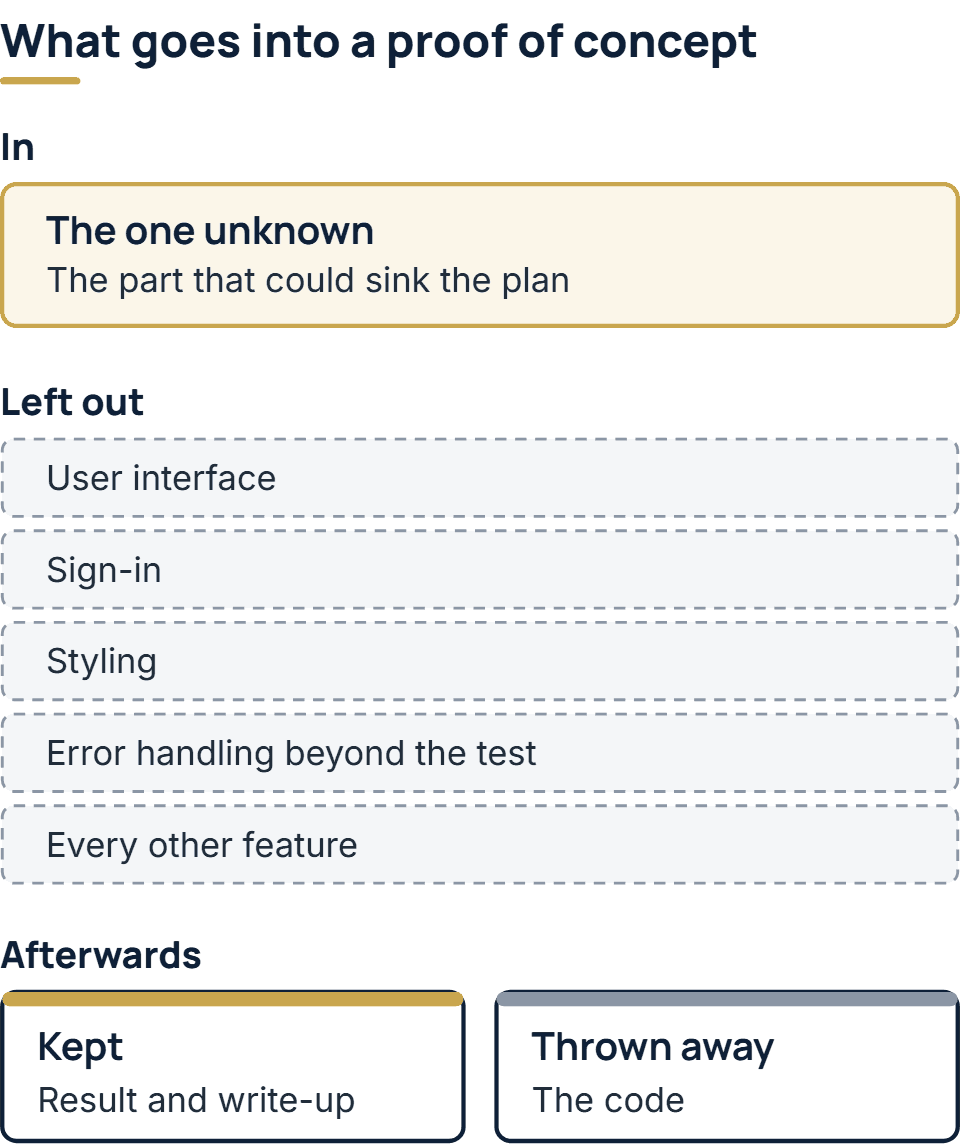
- It is narrow. It tests the part that might fail and leaves out everything else.
- Its success criteria come first. The result that counts as success is agreed before the work starts, so it cannot be argued into a success afterward.
- It is meant to end. What gets built next is built properly, usually from scratch.
Proof of concept in research, security and software
The term shifts a little with who is using it, and the difference matters when you read a grant call, a security advisory or a supplier’s proposal.
| Field | What the proof of concept shows | Where the term is set out |
|---|---|---|
| Research and engineering | Laboratory studies and a model show that a technology is viable, before its component pieces are tested with one another | NASA’s Technology Readiness Levels, level 3 |
| Research funding | An idea from funded research has commercial or societal potential worth testing | The European Research Council’s Proof of Concept grant |
| Security | Exploit code shows that a vulnerability can really be exploited | The CVSS v4.0 standard, Exploit Maturity |
| Software and product | A throwaway program shows that a technical approach works on the problem at hand | Extreme Programming’s spike solution |
In research, NASA’s Technology Readiness Levels run from 1 to 9. At level 2 NASA calls a technology “very speculative,” with little or no experimental proof of concept. Level 3 needs analytical and laboratory studies, and NASA notes that a proof-of-concept model is often built there. Once that model is ready the technology moves to level 4, where multiple component pieces are tested with one another. The European Research Council uses the term for a kind of funding: its Proof of Concept grant, a lump sum of EUR 150,000 for a project of 18 months, is open to principal investigators who hold, or recently held, one of its main grants and helps an idea from that research move toward innovation.
In security, a proof of concept is exploit code that demonstrates a flaw can be used. The CVSS v4.0 specification from FIRST, which defines the Common Vulnerability Scoring System, has an Exploit Maturity metric with a value named Proof-of-Concept: exploit code is publicly available, and no attempts to exploit the vulnerability are known to have been reported. Once attacks are reported, or an exploit kit is available, the value becomes Attacked; with neither public proof-of-concept code nor reported attacks known, it is Unreported. So “PoC available” in an advisory means a working demonstration is public, not that anyone has been hit yet.
In software and business, a proof of concept is a small build that tests whether a technical approach works before a team plans a product around it. That is the sense the rest of this post deals with.
What is a PoC for a project?
In a software project, a PoC is for the unknown that could sink the plan. Most of a project is known work: screens, forms, accounts and reports that teams have built many times. The risk usually sits in a few places. It might be an integration with a system nobody has documented, an algorithm that must be accurate enough, a data source that may not hold what the plan assumes, or a response time that has to hold under real load.
Extreme Programming gave this kind of work a name. In his rule Create a Spike Solution, Don Wells describes “a very simple program to explore potential solutions,” built for the problem under examination while every other concern is ignored. Its purpose is to reduce the risk of a technical problem, or to make an estimate more reliable. He suggests giving the problem to two developers, working as a pair, for a week or two, and he is plain about the result: “Most spikes are not good enough to keep, so expect to throw it away.”
The UK government’s Service Manual applies the same discipline to a whole service. Its alpha phase is for identifying the riskiest assumptions and testing them with prototypes “just complex enough to let you test different ideas, not production quality code,” and teams are told to expect to throw away the code when alpha ends. Alphas there tend to last six to eight weeks, longer than a spike, because the assumptions they test cover users and policy as well as technology, rather than one technical question.
Both sources teach the same lesson. A PoC is cheap because it is allowed to be discarded. Once its code has to be kept, it has to meet the standard of the product, and the saving is gone.
How to run a proof of concept
- Write the question so it can be answered yes or no. “Can we read open orders from the old warehouse system without changing it?” is a PoC question. “Explore the warehouse integration” is not, because it has no end.
- Set the success criteria before any work starts. Make them measurable: a response time at a stated volume, an accuracy rate on a stated sample, record counts that match. Write down, too, the result that would mean stop.
- Name what is out of scope. Usually that is the user interface, sign-in, styling, error handling beyond what the test needs, and every feature that is not the question. A written list protects the time box.
- Fix the time box and the people. For a technical question that means days, or a couple of weeks, with engineers who would build the real thing, so what they learn stays with the team.
- Use real conditions where they are the risk. If the doubt is about data, test on a copy of the real data rather than a tidy sample. If it is about speed, test at the volume the product will face. A PoC that passes on easy inputs says nothing about hard ones.
- Write up the result, then decide. Record what passed, what failed and what the real build should do differently. Then choose: go ahead with this approach, try another one, or stop. Keep the write-up and discard the code.
Proof of concept template
A one-page plan is enough. Fill in the first seven rows before the work starts and the last two when it ends.
| Field | What to write |
|---|---|
| The question | One yes-or-no question about feasibility |
| Why it matters | What the project cannot do if the answer is no |
| Success criteria | The measured result that counts as yes, and the result that means stop |
| In scope | The fewest parts needed to answer the question |
| Out of scope | Everything else, by name, so nobody adds it halfway through |
| Data and environment | Which data (a copy of the real data, or a sample) and where it runs |
| Time box and people | The end date, who builds it and who reviews the result |
| Result | What happened, measured against the success criteria |
| Decision | Go ahead, change approach or stop, and the reason |
What is a proof of concept example?
Three software examples, written for illustration. The businesses, systems and figures in them are invented.
A legacy integration. A distributor wants a customer portal that shows live order status, and its orders sit in a 15-year-old warehouse system with no API. The question: can a new service read open orders straight from that system’s database, read-only, without slowing the warehouse down? The success criteria: every open order in one day’s copy of the data read correctly, and no query slower than one second against a replica. Left out: the portal, sign-in, and any writing back. If it fails, the portal is planned around a nightly export instead, and that change happens before anyone designs a screen.
A speed question. A booking product needs filtered search across two million listings. The question: can the chosen database return results fast enough without a separate search engine? The success criteria: 95% of a set of realistic queries answered in under 300 milliseconds on hardware like production. Left out: ranking, the results page and booking itself.
An AI feature. A finance team wants supplier invoices read automatically. The question: can a document model pull the supplier, date, total and tax from the team’s own invoices accurately enough? The success criteria: at least 95% of fields correct on 200 real invoices from many suppliers, scans included. Left out: approvals and the accounting integration. A model that does well on clean PDFs and badly on scans has still answered the question: not on its own. The real build then plans a human check for scanned invoices from the start.
Proof of concept vs prototype
A proof of concept asks whether something can be built. A prototype asks whether people understand and like how it would work; it is about flow and design, and often has no working system behind it. A minimum viable product goes a step further and asks whether people will use or pay for the product, which takes a release to real users. They can follow one another, and few projects need all three. The MVP development services page sets a proof of concept beside a prototype and an MVP and helps you pick which to build first, and our post on what an MVP is covers the last of the three in depth.
Mistakes that make a PoC prove nothing
- The success criteria are set afterward. Any result can then be read as a success. Agree on the number first, in writing.
- Clean data stands in for real data. An integration that works on a neat sample fails on the record with a missing field. If the data is the risk, test the mess.
- The question is already answered. Proving that a well-known framework can show a form uses up the time box for nothing. Test what the team has not done before.
- The scope grows. A login screen and a dashboard make the demo nicer and teach nothing about feasibility.
- The PoC becomes the product. Code written to be thrown away cuts corners on error handling, security and tests. When a PoC goes well, plan the real build properly instead of extending it.
If you want help with a proof of concept
At Devrisen, working out whether your riskiest assumption calls for a proof of concept, a prototype or an MVP is the first thing our Scope week does, and that advice is included. Scope week is free and ends with a written spec and a fixed quote, and we build all three. Write to us about the part of your idea you are least sure of. You will have an answer from us within one business day.
The full service behind this post: MVP Development Services for Startups.
Ready to scope your project?
Send us two sentences about what you need. We reply within one business day with the next step and any questions we need answered first.