Blog
What is an MVP in software development? Meaning and examples
An MVP is the smallest release that tests a product's riskiest assumption with real users. What the term means, its kinds, and how to scope one.
MVP stands for minimum viable product. In software development it is the first release of a product, built to answer one question with real users: will people use, or pay for, the thing the product assumes they want? It is the least work that gives a trustworthy answer. That is often much less than a first version of the product, and sometimes it is not software at all. Everything else waits until the answer is in.
What does MVP mean?
Eric Ries, who made the term widely known, gave its meaning in a 2009 post: the minimum viable product is “that version of a new product which allows a team to collect the maximum amount of validated learning about customers with the least effort.” He developed the idea further in his book The Lean Startup. Two parts of that sentence carry most of the meaning.
The first is validated learning. The release exists to produce evidence of what customers actually do, measured, rather than what they say they would do when asked. The Agile Alliance glossary draws the same line: watching behavior is more reliable than collecting opinions.
The second is least effort. “Minimum” describes the effort spent, not how small the product looks. Ries said so directly in the same post: an MVP “is not about creating minimal products.” If a test only works when the screen looks finished, the screen has to look finished. If a single web page and a sign-up form can answer the question, the app can wait.
Taken word by word:
- Minimum — only what the test needs, and nothing that will not change the answer.
- Viable — good enough that the people trying it behave as they would with a real product, so the result can be trusted.
- Product — something people actually use or buy, put in front of real users, rather than a plan or a slide about it.
For a startup, the MVP usually tests whether there is a business at all. Inside an established company it tests a new product or a large feature before the full budget is committed. In both cases the release is an experiment, and it has a question attached. Ries also noted that a team which is only scratching a clear itch, or building something to sell on quickly, does not need one.
What an MVP is not
Most trouble with MVPs starts when the word drifts away from its definition. These are the five readings that cause it:
| Often confused with | The difference |
|---|---|
| Version 1 with fewer features | A cut-down version 1 is planned around a launch date. An MVP is planned around a question, and its scope is whatever answers that question. |
| A prototype | A prototype shows how a product would look or work, usually to the team or to users in a test session. An MVP is used by real users in their own setting, so what they do counts as evidence. |
| A proof of concept | A proof of concept tests whether something can be built at all, usually with throwaway code and no users. An MVP assumes it can be built and tests whether people want it. |
| A minimum marketable product | The Agile Alliance separates them by purpose: an MVP is for learning, a minimum marketable product or feature is for earning. |
| The smallest thing a team can build | Scope cut until the product is too weak to judge fails as a test. The glossary describes this as stressing the minimum and losing the viable. |
Kinds of MVP, by what they test
Different questions need different tests, and some of the most useful MVPs involve very little code. From least to most building:
| Kind | What it is | What it can show |
|---|---|---|
| Landing page | A page that describes the product and asks visitors to sign up, join a waitlist or pre-order | Whether the offer interests the people you expect, counted in sign-ups from real visitors |
| Demo video | A short recording of how the product would work, shown to the audience it is for | Whether the idea makes sense to that audience, and how many ask for access |
| Concierge | The service delivered by hand to a few customers, who know a person is doing it | Whether the result is worth paying for, and what the steps really involve |
| Manual behind the scenes | A product that looks automated, with people doing the work behind it | Whether customers use it as a product before the hard part is automated |
| Single-feature product | Working software that does one job properly | Whether people come back to it and pay for it |
The Agile Alliance gives the landing page and the hand-run service that looks automated as examples of an MVP. The first three kinds answer questions about demand. The last two are where most of a build budget goes, and they make sense once demand is no longer the open question.
How to decide what goes into an MVP
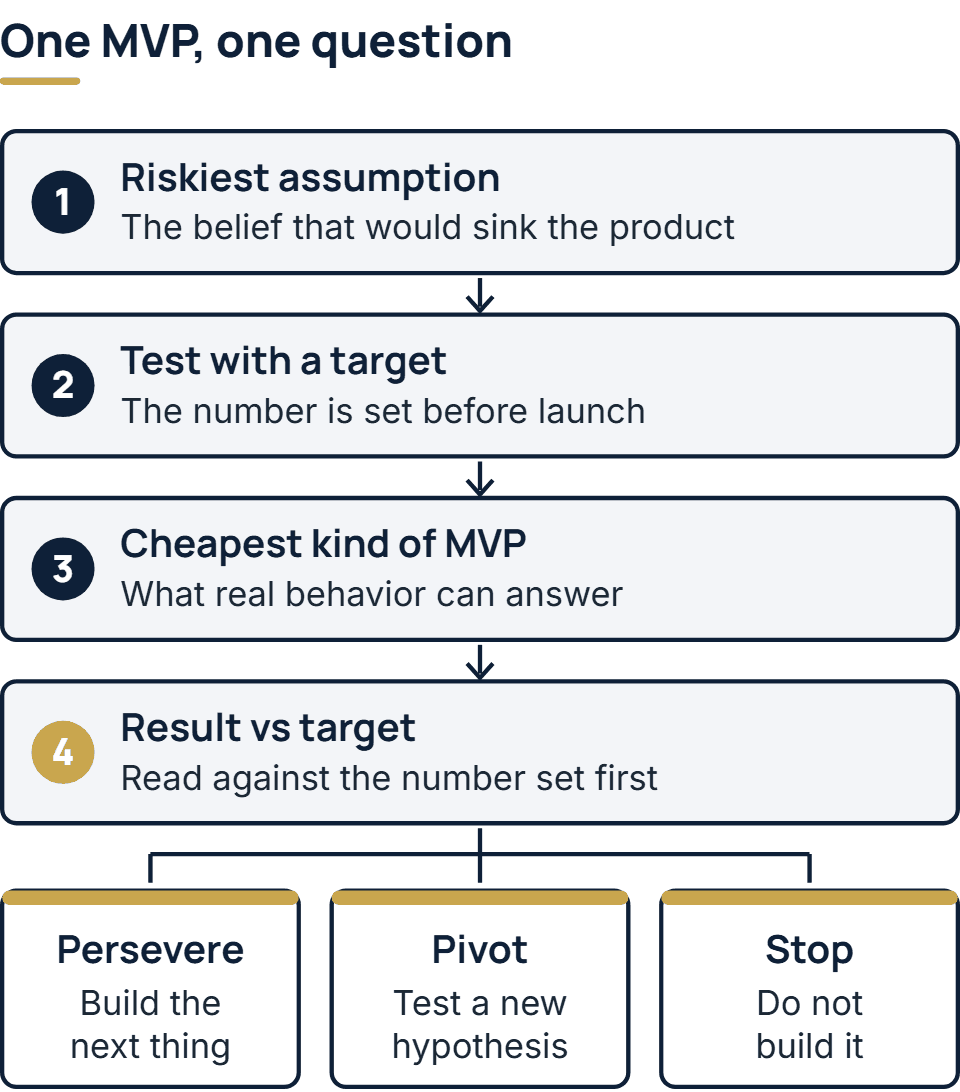
- Write down the riskiest assumption. This is the belief that would sink the product if it turned out to be wrong. It is usually about people: whether they have the problem, whether they will change how they deal with it today, whether they will pay.
- Turn it into a test with a target. A sentence of this shape works: “We believe [these people] will [do this]. We will know we are right if [this measure] reaches [this number] within [this time].” Set the number before launch. A target picked after the results arrive tends to fit them.
- Pick the cheapest kind of MVP that real behavior can answer. Use the table above. A question about demand rarely needs working software.
- List what the test needs to be believable. Include the plain parts that are easy to forget: sign-up, the one path a user takes through the product, payment if paying is the question, a way for users to reach you, and the analytics that measure the target.
- Cut everything else, and write the cuts down. A short list of what was left out, and why, settles the arguments that come up during the build.
- Fix a date. An MVP that takes a year to build has stopped being minimum. The US government’s Digital Services Playbook asks federal teams to ship a functioning MVP that solves a core user need “as soon as possible, no longer than three months from the beginning of the project”.
A worked example
Take a hypothetical tool that helps restaurants fill tables after late cancellations by texting diners on a waitlist. The numbers here are for illustration.
| Step | For the waitlist tool |
|---|---|
| Riskiest assumption | Diners on a waitlist will take a table offered by text at an hour’s notice |
| Test and target | We believe waitlisted diners at two restaurants will accept short-notice tables by text. We are right if at least a third of the tables offered are taken within four weeks. |
| Kind of MVP | Concierge: staff send the texts by hand from a shared phone, with the waitlist kept in a spreadsheet |
| What it needs | Diners’ agreement to be texted, a short message script, a log of every offer and reply |
| Left out | A link to the booking system, automatic messages, an app for diners, reports |
| If it passes | Build the single-feature product: the waitlist and automatic offers, connected to one booking system |
Nothing in that test needs a line of code, and a failed result costs four weeks of a few staff members’ time instead of a finished product.
Viable includes safe
An MVP with real users holds real data, so it needs a floor of security even when nearly everything else has been cut. Version 5.0 of OWASP’s Application Security Verification Standard describes its Level 1 as “the minimum requirements to consider when securing an application”: around a fifth of the standard, covering basic, first-layer defenses against common attacks. The standard’s own example is an early-stage startup collecting limited sensitive data, which may decide to focus on Level 1 at first. That makes Level 1 a sensible floor for most MVPs, with the higher levels added as the product and the data it holds grow.
It is also worth deciding before the build whether the code will be kept or replaced once the test is over. The answer changes how much testing and structure the build needs, and changing it halfway costs more than either choice.
What happens after an MVP
The result is read against the target set beforehand, and it leads to one of three moves:
- Persevere. The assumption held. Build the next most important thing, often by automating what was done by hand, and set the next question.
- Pivot. The Lean Startup principles describe a pivot as “a structural course correction to test a new fundamental hypothesis about the product, strategy and engine of growth.” In practice that means changing the customer, the problem, or the way the product solves it, and running a new test.
- Stop. The evidence says the product should not be built. That is a good outcome compared with learning the same thing after a full build.
The Agile Alliance lists one more trap: shipping an MVP and then ignoring the feedback that should change the product. A result is only useful if the people who own the product have agreed, before the test, to act on it.
If you want us to build your MVP
At Devrisen an MVP starts with a free Scope week, in which we write the spec with you and finish with a fixed quote for the build. The senior engineers and the product designer in those sessions are the people who then build the product. You watch working software in a demo each week, monitoring goes live with the launch, and under the contract the code, with its intellectual property, is yours. Our page on MVP development services sets out each phase and where a proof of concept or a prototype fits before an MVP. Or write to us; a reply comes within one business day.
The full service behind this post: MVP Development Services for Startups.
Ready to scope your project?
Send us two sentences about what you need. We reply within one business day with the next step and any questions we need answered first.