
Blog
Software development for startups: who builds it and what to own
Software development for startups means building to learn, on little money. Who should build version one, what the company must own, and when to hire.
Software development for startups is building a product while the company is still finding out whether anyone wants it. The first code has a different job from the code a settled business writes. It exists to answer a question about customers as cheaply and quickly as the answer allows, and much of it will be rewritten or thrown away once the answer arrives.
A few early choices outlast that code. Who owns it, which accounts it runs in, which licenses it carries and which shortcuts were taken on purpose all travel with the company into its first business sale, its first funding round and its first hire. This guide covers what the software is for at each stage, who should build the first version, how to hire your first developers, what the company should own from the start, and which technical debt is safe to take on.
What the software is for at each stage
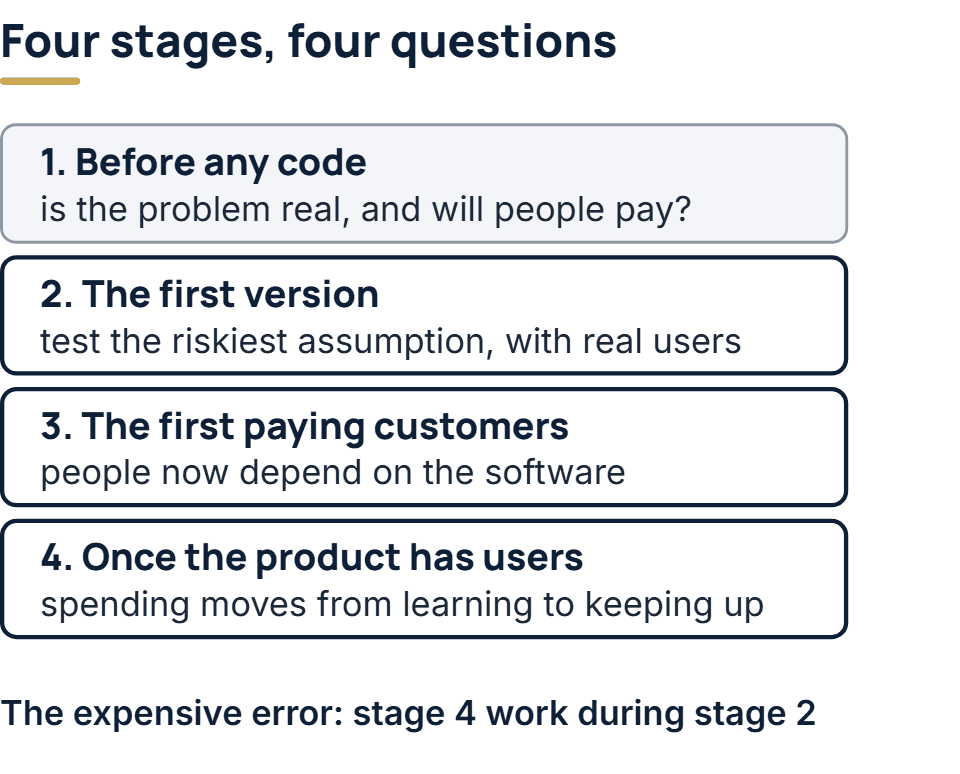
A startup’s software passes through four stages, and each one asks a different question of it.
- Before any code. The question is whether the problem is real and whether people will pay to have it solved. Conversations, a landing page or a service run by hand can answer it while code waits. Where the doubt is technical, such as whether an integration can work at all, a small proof of concept answers that one question and nothing more.
- The first version. Its job is to test the riskiest assumption with real users. Scoping one is the subject of our MVP explainer, and a user story map is a practical way to decide where release one ends.
- The first paying customers. Now people depend on the software, so backups, monitoring, a way to report bugs and releases that do not break their work start to matter more than new features. Business customers also begin to ask how their data is protected. Some ask for a SOC 2 report, which in the AICPA’s own words covers an examination of controls at a service organization relevant to security, availability, processing integrity, confidentiality or privacy. Few startups need the report this early. The habits it looks at, such as who has access, how changes are reviewed and how data is backed up, cost far less to start now than to retrofit.
- Once the product has users. Spending moves from learning to keeping up: hiring, repaying the debt taken on in stage 2, and speeding up the parts that measurements show are slow.
The expensive error is doing stage 4 work during stage 2, building for a scale the company does not have and for customers it has not met yet.
Who should build the first version?
There are six common routes. Each costs something besides money, and the right one depends on what the founders can do themselves and how long the product will need a team.
| Route | It suits a startup when | What it costs besides money | Watch for |
|---|---|---|---|
| A technical co-founder | Someone with the skills cares about the problem as much as you do | A share of the company, and a partnership that is hard to undo | Agree who decides what, and put vesting and rights in the code on paper before the first commit |
| A founder writes it | The product is simple, or a founder already codes | Founder time taken from selling and from talking to users | Code that nobody else has read, kept in a personal account |
| A no-code tool | Version one is mostly forms, lists and workflows | Limits on what the product can do, and the vendor’s pricing | Whether the data and the logic can be moved out when you outgrow it |
| Freelancers | The work is small and well defined, or one skill is missing | Your time spent directing them and fitting their pieces together | Who you call when a problem is beyond them, and a signed transfer of the code |
| A development company | The product needs a team now and nobody on staff can lead the build | Less day-to-day control than over your own staff | Whether the people who scope it also write it, how you will see progress, and the ownership terms |
| Your own first hires | You have funding and time to recruit, and the product will need a team for years | Months of recruiting before the work starts | A lone first engineer whose code nobody reviews |
Startups often move between routes. A frequent pattern keeps product decisions with a founder, has a co-founder or an outside team write version one, and moves the work to employed engineers once the product has users. Whatever the mix, the founder who decides what to build should never be the only person able to reach the code, and nor should any single developer.
How to hire developers for a startup
Decide which role you are filling before you look for a person. Three roles get confused:
- Technical co-founder. An owner of the company who shares its risk and makes the long-term technical calls. Co-founder shares are usually granted with vesting, so that someone who leaves early does not keep a full stake. Have a lawyer set the terms.
- First engineer. An employee who builds the product day to day. The strongest first hire has shipped a product and kept it running, and is comfortable working on the database, the interface and the deployment in the same week. A narrow specialist usually comes later.
- Part-time technical advisor. An experienced engineer who reviews decisions and code for a few hours a week. This suits a founder whose product is being built by outside developers and who wants an independent opinion on their work.
A founder who does not code can still hire well by borrowing judgment. Ask an engineer you trust to sit in on the technical interview. Give each candidate a small paid task close to the real work, such as adding a feature to a codebase you supply. When you take up references, ask someone who worked beside the candidate on a live product what they did the last time it broke. Our guide to building a software development team covers structured interviews and the order of later hires.
Settle two pieces of paperwork in the first week of any hire. One is employment status, since calling someone a contractor does not decide it: the tests the IRS applies are set out in our post on in-house versus outsourced development. The other is a signed agreement assigning to the company what the person creates for it, including anything they wrote before joining that goes into the product.
What the company should own from the start
In a young company an account often belongs to whoever opened it, and that person may leave the company or lose the password. Moving ownership afterwards takes signatures and support tickets, sometimes in the middle of a funding round’s due diligence, when time is short. Put these in the company’s name from the beginning.
- The code and the rights in it. Under US copyright law, paying for code does not by itself make it yours. Apart from transfers by operation of law, a transfer of copyright ownership is valid only in writing, signed by the owner or the owner’s authorized agent, under 17 U.S.C. §204(a). That applies to code a founder wrote before the company was formed, code from freelancers and code from a development company. The post on how to choose a development company explains why a “work made for hire” clause alone may not be enough. Other countries have their own rules; take legal advice before relying on any of this.
- The repository. Keep the code in an organization account the company controls, and add contractors as members you can remove. GitHub recommends at least two owners for each organization: when a sole owner cannot be reached, the organization’s projects may be cut off.
- The cloud account. AWS’s root user guidance says to use the root user only for tasks that require it, create an administrative user for everyday work, protect the root sign-in with multi-factor authentication, create no access keys for it, and use a group email address for its credentials. The group address keeps the account from depending on one person’s inbox.
- The domain name. Register it with the company as the registrant. Pay the renewal from a company account, with the notices going to a shared address. When a domain lapses, the website and the company’s email go with it.
- App store accounts. On the App Store, an individual member’s own legal name is shown as the seller of their apps. To show the company’s name instead, the company enrolls as an organization, and Apple’s enrollment requirements for that include a legal entity that can sign contracts (trade names are not accepted), a D-U-N-S number, a work email on the organization’s domain and a working public website. Google Play’s organization accounts also need a D-U-N-S number, taken from the linked payments profile. Dun & Bradstreet issues the number free, so request it well before a mobile app has a launch date.
- The licenses you build on. Every open source package comes with a license, and most ask little of you. A few ask more. The GNU Affero GPL adds one requirement to the ordinary GPL: if you run a modified version on a server and let people use it there, the server must also let them download the source code of that version. For a product delivered as hosted software, that can mean letting your users download the source of your modified version. How far the obligation reaches when such a package is built into your own product is a question for a lawyer, before the package goes in. Keep a list of the packages in the product with their licenses, and check it whenever one is added.
Technical debt: the shortcuts worth taking
Ward Cunningham introduced the debt metaphor in a 1992 experience report: releasing code written for the first time is like borrowing money, and a small debt speeds up development provided it is paid back promptly. Martin Fowler later divided debt by two questions in his Technical Debt Quadrant: was it prudent or reckless, and was it taken on deliberately or without the team noticing? A startup should borrow. The debt it takes on should be the prudent, deliberate kind, chosen with the cost of paying it back in view.
This is how we sort the common shortcuts:
| Usually fine to leave for later | Costly to put right later |
|---|---|
| Admin tasks done by hand, such as approving sign-ups or issuing refunds | Passwords stored in plain text or with a fast hash, where OWASP’s password storage guidance calls for a slow algorithm such as Argon2id, bcrypt or PBKDF2 |
| One application deployed as a single unit instead of many services | In a product sold to companies, records with nothing saying which customer company they belong to |
| Invoices raised by hand for the first customers | Backups that nobody has ever restored to prove they work |
| Plain screens built from a standard component library | Passwords and keys committed to the code repository |
| A fixed server size with no automatic scaling | No automated tests on the paths that take or refund money |
| Reports exported to a spreadsheet | Accounts and code held in one person’s name |
The left column can wait because doing it later costs about the same as doing it now. The right column grows with every customer and every row of data, and it tends to surface at a bad moment: a large customer’s security review, or an investor’s technical due diligence. Keep a short written list of the debt you took on deliberately, each item with the event that will trigger repaying it, such as the tenth customer or the first enterprise contract.
How we build first versions for startups
Our MVP development services for startups begin with Scope week, which costs nothing. By its end you hold a spec in writing and a fixed quote itemized line by line, and you decide whether to go ahead only after reading it. The engineers and the designer who scope it go on to build it, and each week of the build ends with a demo of the running product. A founder who does not write code signs off each design before it is built, and gets a technical sounding board as part of the engagement on what to cut, what to do by hand for now and what has to be engineered.
Under the contract your company owns the code and its intellectual property outright, and the code, hosting and accounts are handed over in your name. If a first version already exists, the first step is a short paid audit of its code, and you get a fixed-price plan whatever the audit finds. Write to us; the reply arrives within one business day.
The full service behind this post: MVP Development Services for Startups.
Ready to scope your project?
Send us two sentences about what you need. We reply within one business day with the next step and any questions we need answered first.