
Blog
What software is used in healthcare, and who relies on each system
Most healthcare runs on an electronic health record, with billing, lab, imaging, pharmacy and patient systems around it. What each holds, and how they connect.
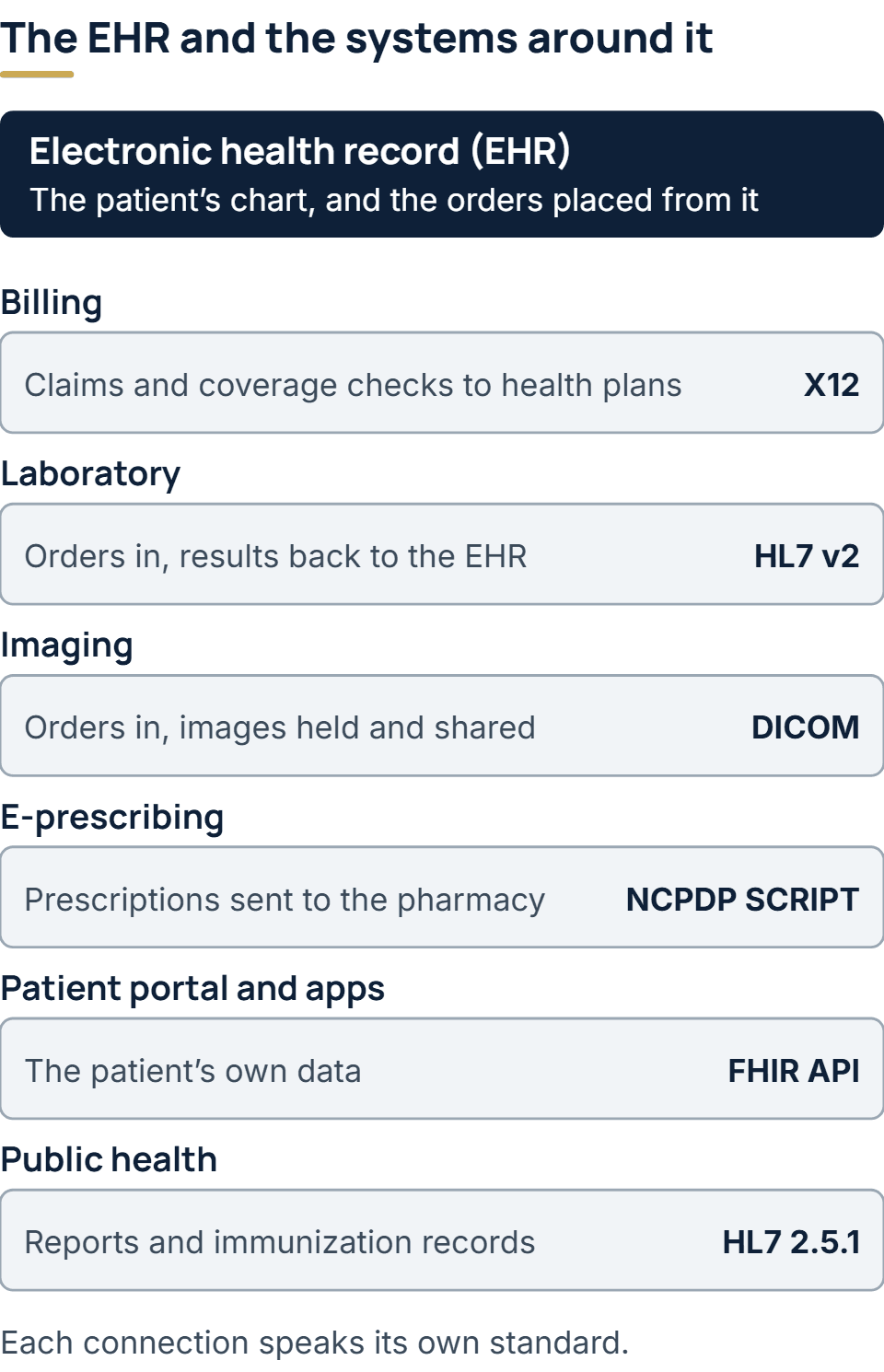
At the center of most clinics and hospitals is an electronic health record (EHR), the system that holds each patient’s chart. The other software is arranged around it. Billing exchanges claims with health plans, the laboratory and imaging departments receive orders and return results, prescriptions travel to pharmacies, and patients reach their own records through a portal or an app. Guides to the types of healthcare software count anywhere from a handful to dozens, mostly because they split and name the same systems differently. This one groups them by what each system holds and which people depend on it, then explains how they exchange data.
The sources are the bodies that write the rules and the standards: the Office of the National Coordinator for Health IT (ONC), the Centers for Medicare & Medicaid Services (CMS), HL7 International, and the publishers of the DICOM standard. The regulations quoted are American. HL7’s standards and DICOM are international, so the parts about how systems connect apply well beyond the US.
The systems, and who depends on each
| System | Who depends on it | What it holds or sends |
|---|---|---|
| Electronic health record (EHR) | Physicians, nurses and other clinicians, and patients through the portal | The chart: problem list, medication and allergy lists, lab results, vital signs and notes, plus the orders a clinician places for medicines, lab tests and imaging |
| Practice management and billing | Billing and front-desk staff | Claims sent to health plans, checks of a patient's coverage, claim status, and the payment and remittance advice that comes back |
| Laboratory system | Lab staff, and the clinicians waiting on a result | Orders received from the EHR and the results returned to it; some results also go to public health agencies |
| Imaging systems | Radiologists, technologists and the clinicians who ordered the scan | Images from X-ray, CT, MRI and ultrasound equipment, with their related information, held and exchanged in DICOM |
| E-prescribing and pharmacy | Prescribers and pharmacists | Prescriptions sent from the point of care straight to a pharmacy, and the patient's medication history |
| Clinical decision support | Clinicians, at the moment they decide something | Alerts and reminders, order sets for a condition, documentation templates and diagnostic support, fed by the patient's own data; it runs inside the EHR or as a separate system or plug-in |
| Patient portal and apps | Patients, and the people they authorize | The patient's own health information, to view, download or send to a third party; apps the patient chooses reach the same data through the EHR's API |
The EHR rows follow ONC’s certification criteria for health IT (45 CFR 170.315), which include order entry for medications, laboratory and imaging, decision support interventions, electronic prescribing and patient access to the record among the capabilities health IT can be certified for. ONC’s own page on clinical decision support describes the tools in that row. The billing row follows the transactions CMS lists as HIPAA standards.
A clinic and a hospital
A small practice may run little beyond an EHR and its billing. Its lab work and scans often go to outside laboratories and imaging centers, and the results come back into the chart. ONC’s explanation of the EHR rests on exactly that: it is built to share information with laboratories, specialists and other providers, so the record follows the patient.
A hospital that runs its own laboratory, imaging and pharmacy departments has a system for each, so far more of the traffic stays inside one building. That is where HL7 says its Version 2 messages are prominent: in in-patient settings, throughout the world, though they are used in other settings too.
How the systems exchange data
HL7 Version 2
HL7 Version 2 was HL7’s first standard for exchanging information and is still one of its most widely adopted. A v2 message is made of reusable segments and goes from one system to another, either to pass on information or to make the receiver act, as when a lab order arrives or a patient is transferred. Local additions travel in “Z-segments”, and HL7 notes that their meaning is opaque unless the sender explains it. That is why two v2 interfaces between the same kinds of system can still differ, and why each one is agreed and tested on its own. In the US, version 2.5.1 is the standard the regulations name for reporting to public health agencies, for immunization registries and for sending lab results to public health (45 CFR 170.205).
FHIR
FHIR (Fast Healthcare Interoperability Resources) is HL7’s newer framework. Data is exchanged as “resources”, such as a patient, a provider, an organization or a medication, using ordinary web technology: JSON or XML over HTTP, with OAuth for authorization. It supports REST APIs as well as messages and documents, and HL7’s summary presents it as able to coexist with Version 2 and with HL7’s clinical document standard, CDA. US certified health IT has to offer a standardized API for patient and population data built on FHIR Release 4.0.1, with the US Core profiles and the SMART App Launch framework for connecting apps (45 CFR 170.215). For anyone building an app that reads from an EHR, that API is the front door.
The other standards in the picture
- DICOM — the international standard for medical images and the information around them, built into nearly every radiology, cardiology imaging and radiotherapy device, and recognized as ISO 12052 (DICOM Standard).
- NCPDP SCRIPT — the standard that carries electronic prescriptions and medication history between prescribers and pharmacies (CMS).
- ASC X12 — the standard for the HIPAA transactions with health plans, such as claims, eligibility checks and remittance advice; certain pharmacy transactions use NCPDP instead (CMS).
Where the handoffs go wrong
An order and its result
A lab or imaging order leaves the EHR, and the result has to come back attached to the right patient and the right order. When either side upgrades or changes how it fills a field, an interface that worked for years can start dropping or misfiling messages, and nobody sees it until a clinician goes looking for a result that is not there.
The chart and the claim
A claim is built from what was documented during care. If the billing system and the EHR hold different versions of a patient’s details or of what was done, the claim goes out wrong, or not at all, and the gap surfaces later as a denied or delayed claim.
What the patient can see
The portal and patient apps show what the EHR holds. A result that stays in the lab’s system and never reaches the chart is missing for the patient too, and so is anything held in a spreadsheet beside the official systems.
Where custom software fits
The core systems are bought, and they should be. In the US an EHR is certified against ONC’s criteria, and rebuilding one, or a billing or lab system, rarely pays anywhere. Custom software earns its place around them. It connects systems their vendors never connected, covers a workflow no product handles the way an organization does it, brings data from several systems into one report, or reaches the EHR through its FHIR API to put something in front of patients or staff that the record does not show.
Any of that work handles patient data, which brings HIPAA in from the start. The regulation applies to covered entities, meaning health plans, health care clearinghouses and providers that conduct certain transactions electronically. A company that creates, receives, keeps or transmits protected health information for a covered entity is that entity’s business associate, and the definition names billing and practice management among the functions involved (45 CFR 160.103). So which records the software touches, who may see them and what the audit trail must show are questions for the first week of a project, not the last. Engineers on our team have worked under HIPAA and GDPR. The security work that follows is set out stage by stage in our guide to secure web application development.
Connecting new software to the systems an organization already runs is the integration work described on our enterprise software development page. Interfaces also need looking after once they are live, because the systems on either side keep changing versions, which is ongoing software maintenance rather than a one-off job.
Questions people ask
What is the difference between an EHR and an EMR?
People often use the two terms interchangeably. ONC draws a line between them in a 2011 explainer: an electronic medical record replaces the paper chart inside one practice, and its information does not travel easily outside that practice. An electronic health record is built to share information with laboratories, specialists and other providers, and the patient can reach it too. ONC itself almost always says “EHR”.
Does HIPAA apply to every piece of healthcare software?
Not automatically. It depends on whose data the software handles and for whom. The regulation covers health plans, clearinghouses and providers that conduct standard transactions electronically, along with the business associates that handle protected health information for them. The definitions in 45 CFR 160.103 are the place to start, and a lawyer is the person to confirm how they apply to a particular product.
What is FHIR used for?
HL7 lists mobile apps, cloud communications, sharing data from EHRs and server-to-server communication inside large providers. In the US, the most visible use is the API certified health IT must offer, which lets patients’ chosen apps and other systems request a patient’s data in a standard form.
Should a clinic buy or build its software?
Buy the core systems: the EHR, billing, and lab or imaging systems where the clinic runs its own. Build only what sits between or beside them, where no product fits the way the clinic works. A custom build that replaces a certified EHR takes on years of rules, standards and certification that the product already carries.
The full service behind this post: Enterprise Software Development Company & Services.
Ready to scope your project?
Send us two sentences about what you need. We reply within one business day with the next step and any questions we need answered first.