
Blog
The four types of software maintenance, with examples
Software maintenance comes in four types: corrective, adaptive, perfective and preventive. What starts each one, with examples from a live web app.
The four types of software maintenance are corrective, adaptive, perfective and preventive. Corrective work fixes faults that users or monitoring have found. Adaptive work keeps the software running when something around it changes. Perfective work improves what the software already does. Preventive work finds and removes faults before anyone meets them. The IEEE Computer Society lists the same four, and it adds a point that budget holders often miss: the majority of maintenance cost goes on enhancements, not on repairing defects.
This guide explains each type, where the grouping comes from, and how the four show up in a maintenance contract, with examples from one ordinary web application.
What are the four types of software maintenance?
| Type | What starts it | Example in a live web application | Reactive or planned |
|---|---|---|---|
| Corrective | A fault someone has found: a user report, an error alert, a failed job | Invoices for one customer group stop going out after a data change | Reactive |
| Adaptive | A change outside the software: a runtime, an operating system, a browser, a service it calls | The payment provider announces the end of the API version the checkout uses | Reactive to the change, but usually with notice |
| Perfective | Users or the business asking for more, or the team improving speed or structure | Staff ask for a filter on the orders report; a slow page is rewritten | Planned |
| Preventive | A latent fault or a weak spot nobody has hit yet | A date calculation that will break at the end of the year is corrected in November | Planned |
The table describes intent. The same code change can belong to different types depending on why it was made: rewriting a query because a report times out is corrective, and rewriting it because the data is growing and it will soon time out is preventive.
Where the four types come from
The Guide to the Software Engineering Body of Knowledge (SWEBOK), published by the IEEE Computer Society, says in its chapter on maintenance that three categories of maintenance, corrective, adaptive and perfective, were already defined, and that the maintenance standard IEEE 14764 includes a fourth, preventive.
The same chapter gives the definitions this guide follows. Corrective maintenance is the reactive repair of problems discovered after delivery. Adaptive maintenance keeps the product usable in a changed or changing environment. Perfective maintenance provides enhancements for users and also covers better documentation and recoding for performance or maintainability. Preventive maintenance detects and corrects latent faults before they become failures in use. SWEBOK also names emergency maintenance: an unscheduled change that keeps the software running until the proper corrective fix is made.
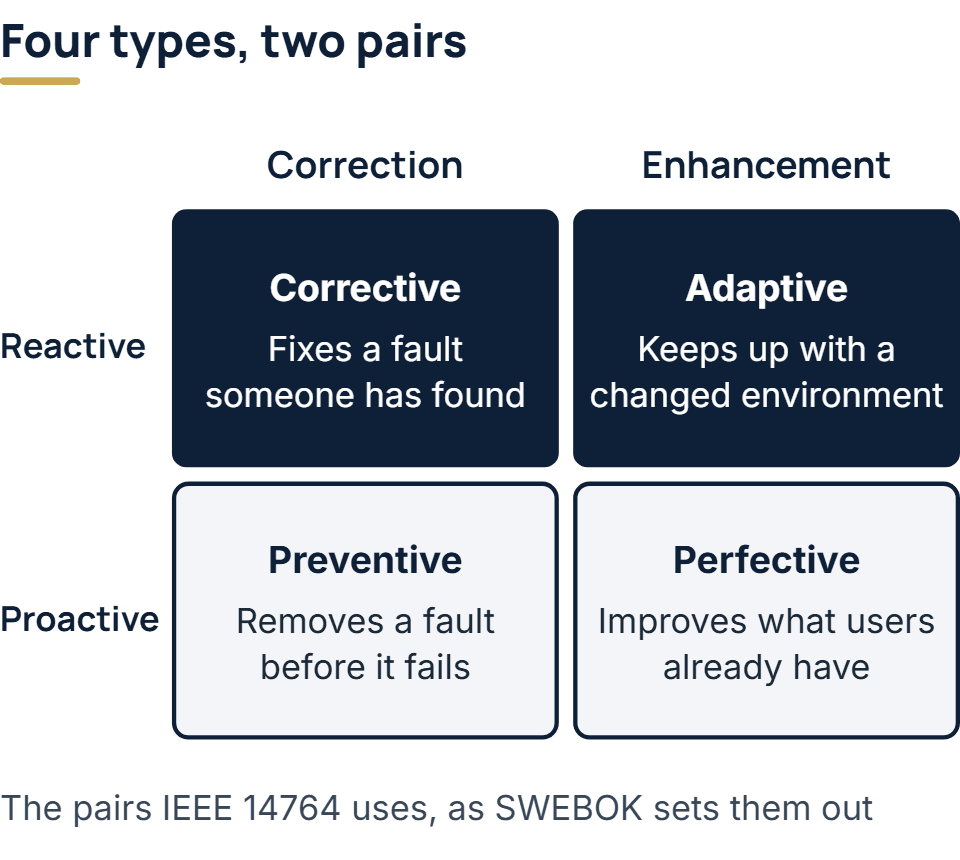
IEEE 14764 then sorts the four into two pairs. Corrective and preventive work are correction: both deal with faults, one after a failure and one before. Adaptive and perfective work are enhancement: both change what the software does or where it can run. SWEBOK’s table adds a second split. Corrective and adaptive work are reactive, a response to something that has already happened. Preventive and perfective work are proactive, started by the team before anything forces it.
Which type takes the most work?
Not bug fixing. SWEBOK states that studies put over 80 percent of maintenance effort into noncorrective work, and the IEEE Computer Society’s overview says most of the cost comes from evolutionary enhancements. The chapter also notes why the opposite belief persists: when enhancements and corrections are reported together, corrections look dearer than they are.
For an owner, the practical reading is this. A maintenance budget sized only for things that break will be short. Most of the time goes on keeping pace with the environment and on the improvements users ask for once they rely on the system every day. None of that shows up as a fault, so it is easy to leave out of the plan.
Examples of each type
Corrective
A customer reports that the password reset email never arrives. The cause turns out to be a mail setting changed during a hosting move. The fix itself takes minutes. Finding it took longer, which is why the useful end of corrective work is often a note of what changed and a way to spot the same failure sooner.
Adaptive
A web application depends on more than its own code. The language runtime it runs on reaches the end of its security support. A browser release changes how a form control behaves. The email or payment service it calls retires the API version it was built against. Each of these comes with a date, which is what makes adaptive work plannable even though it starts outside the team’s control. Keeping dependencies patched is adaptive and preventive work at once, and our guide to secure web application development covers that part of it after launch. When the platform underneath has to change completely, the work becomes a move to a new environment, which our post on what software migration is explains.
Perfective
Six months after launch, the finance team wants the orders report split by region, and support staff want a search that finds a customer by phone number. Neither is a fault. Perfective work also includes changes users never see, such as tidying a module so the next feature takes days rather than weeks.
Preventive
A library the application uses has a published vulnerability that nothing has exploited yet. A database table is growing toward the size at which a nightly job will run past its window. Preventive work deals with both before they turn into incidents. Because every change can disturb something else, it also leans on regression testing, which our article on the levels of testing explains.
How the types show up in a maintenance contract
A contract rarely names the four types, but it handles each of them. Corrective work is governed by a severity table: how an issue is classed, and the response and resolution times for each level. Adaptive and preventive work belongs on a schedule, because both are known in advance if someone is watching. Perfective work needs a boundary, because requests for improvements do not stop.
That is how the retainers in our software maintenance work are set up. The price is fixed per month and the scope is written down before the first month, and the contract sets response and resolution times for each severity level. Each month covers security patches and dependency updates, runtime and framework upgrades while the current version is still supported, fixes in severity order, monitoring, changes forced by third parties, and small improvements users ask for. When improvements grow into a roadmap, they move out of the retainer into a fixed-scope build or a dedicated team. A larger change to how the product works is project work for a custom web development company, which we also are.
Whoever looks after your software, it is worth asking how much of their time goes to each type. A team that only ever reports fixes is either running a fragile system or not counting the rest of its work.
The full service behind this post: Software Maintenance Services & Support.
Ready to scope your project?
Send us two sentences about what you need. We reply within one business day with the next step and any questions we need answered first.